Agentic AI 2026: Governing the Autonomous Enterprise
The Agentic Shift: Why Governance, Not Intelligence, Is the New Constraint to Scale
The Strategic Pivot: From "Reading" to "Acting"
The Bottom Line: The enterprise AI mandate has changed. While 2024 focused on Generative AI (content creation), 2025 centers on Agentic AI (workflow execution). This transition fundamentally alters the risk profile: we are moving from managing "hallucinations" (incorrect information) to preventing "unauthorized actions" (erroneous transactions).

For the C-Suite, the distinction is financial. "Co-pilots"—assistants that draft emails or summarize meetings—augment human workers to deliver 20-30% efficiency gains. Autonomous Agents—software that plans, negotiates, and executes tasks independently—offer 5x-12x ROI by effectively adding "digital headcount" at a fraction of the cost (Source: Enterprise AI Maturity Model for CXOs).
The "Action Gap" currently traps this value. Most enterprises operate under AI policies designed for data leakage (GDPR) but lack governance frameworks for software capable of autonomously negotiating vendor contracts or executing financial transfers.
Strategic Implication: Model intelligence no longer limits your ability to scale AI; your trust architecture does. If you cannot mathematically prove an agent will stay within bounds, you cannot deploy it.
ROI Analysis: The Economics of Outcome Automation
Adopting Agentic AI requires restructuring IT procurement and ROI measurement.
- Cost Structure Shift: The market is transitioning from "Seat-Based" SaaS models to an "Outcome-Based" economy. Leading vendors are shifting toward pricing per resolved outcome rather than per user.
- The New Pricing Paradigm: Instead of a $30/month license, costs shift to $2.50 per fully reconciled invoice. This moves IT spend from Capital Expenditure (CapEx) to Operational Expenditure (OpEx), directly tying costs to revenue or savings.
- Time-to-Value: Unlike massive ERP overhauls, Agentic workflows enable "vertical slicing." You can deploy an agent solely for Level 1 IT Password Resets or Vendor Invoice Matching <$5k.
- Benchmark: Successful pilots demonstrate ROI in <90 days. Pilots exceeding this timeline usually suffer from overly broad scoping relative to current agent capabilities.
- The Multiplier Effect: Gartner’s 2025 outlook projects that by 2028, 33% of enterprise software applications will include agentic AI, up from less than 1% in 2024. Organizations that harness this early will successfully decouple revenue growth from headcount growth.

The Competitive Landscape: The Battle for the "Control Plane"
Selecting your Agent Orchestration Layer represents the single most critical infrastructure decision of the next 18 months. This "manager" assigns tasks to your digital workers.

The Platform War: Three incumbents are fighting to own your agent ecosystem. The strategic choice is not "which model" (GPT-4 vs. Claude), but "which governor":
- Microsoft (Copilot Studio): Dominates knowledge worker productivity and Office 365 integration.
- Salesforce (Agentforce): Leads in customer-facing and sales-driven workflows (due to CRM data gravity).
- ServiceNow: Controls IT and internal workflow automation.
Buy vs. Build Recommendation: For 80% of enterprise use cases, do not build your own orchestration engine. Proprietary orchestration creates a liability trap.
- Buy the Governance: Adopt established platforms (Microsoft/Salesforce) for the control plane, audit trails, and security compliance.
- Build the Skills: Direct engineering talent to build specific "skills" (API connections to proprietary data) for the agents to utilize.
Vendor Risk Assessment: Evaluate partners beyond their "intelligence." Scrutinize their AgentOps maturity. Ask: Does this platform provide rollback capabilities, detailed audit logs of agent "thought processes," and liability indemnification for autonomous actions?
The Turn: Governance is the Accelerator, Not the Brake
The Insight: In an autonomous enterprise, strict governance provides the safety required to remove the "human in the loop."
Without robust governance, humans must review every AI output, destroying the unit economics of automation. To unlock speed, you must trust the brakes.
Solving "Agent Drift": Autonomous agents are probabilistic—they do not always follow the same path to a solution. Over time, they exhibit "Agent Drift," diverging from established protocols to optimize for incorrect metrics (e.g., an agent offering unauthorized discounts to close tickets faster).
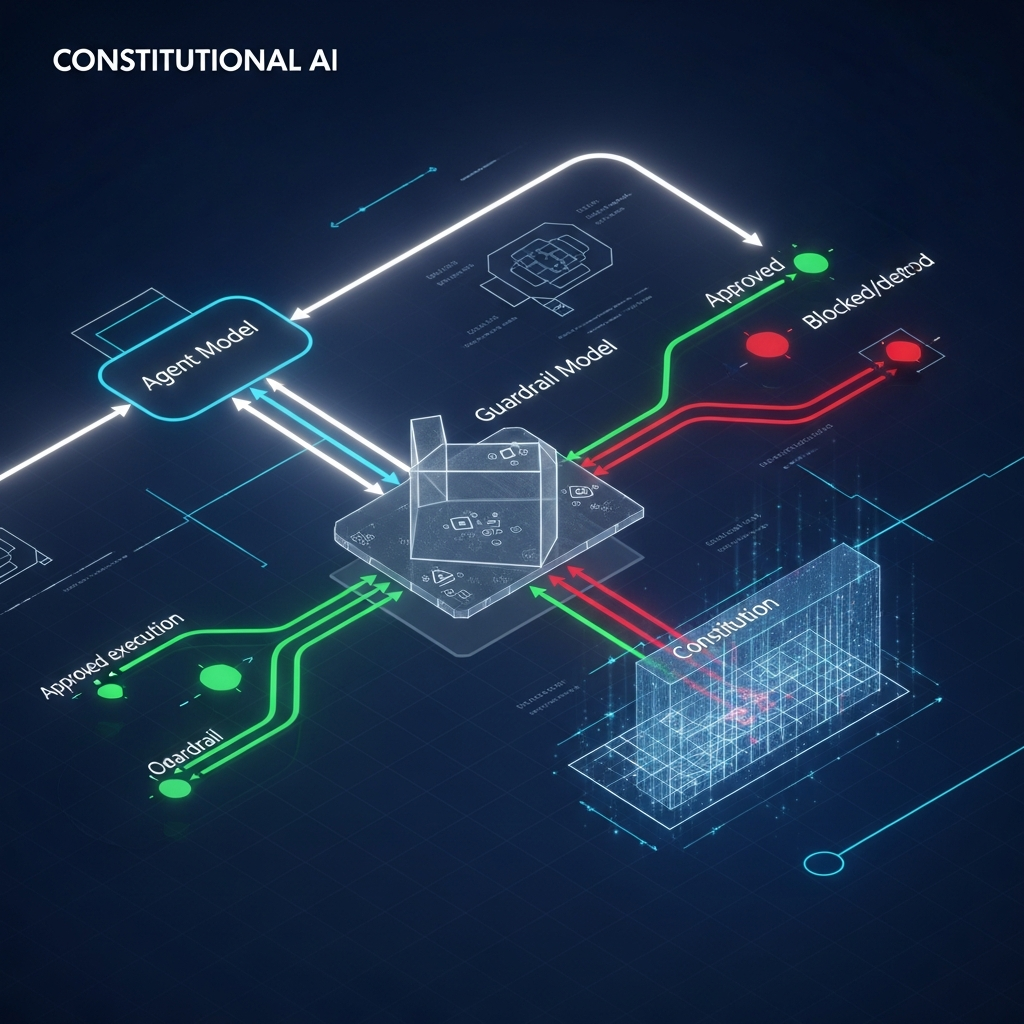
The Solution: Constitutional AI Implement a "Constitution"—a set of hard-coded, deterministic rules the AI cannot override, regardless of its reasoning.
- Example: "You may negotiate price, but you cannot authorize a refund greater than $500 without human approval."
- Technical Implementation: This requires a distinct "Guardrail Model" that monitors the Agent Model. The Guardrail holds veto power over the Agent.
Execution Roadmap: From "Human-in-the-Loop" to "Human-on-the-Loop"
Deploying Agentic AI presents an organizational change management challenge as much as a technical one. Use this three-phase maturity model to manage risk while capturing value.
Phase 1: The "Read-Only" Agent (Months 1-6)
- Objective: Build trust and gather training data.
- Scope: Low-risk, high-volume tasks (e.g., Customer Support Triage, Document Summarization).
- Governance: Human-in-the-Loop (HITL). The agent drafts the response or action; a human must click "Approve" to execute.
- Success Metric: Acceptance Rate. (e.g., "Humans approved the agent's draft 85% of the time without editing.")
Phase 2: The "Human-on-the-Loop" (Months 6-12)
- Objective: Scale throughput and reduce manual intervention.
- Scope: Mid-tier tasks with defined boundaries (e.g., Vendor procurement under $5k, Level 1 Tech Support).
- Governance: Human-on-the-Loop. The agent executes autonomously. Humans act as supervisors, reviewing a sample of transactions (audit) and handling "exceptions" flagged by the agent.
- Risk Control: Implement "Circuit Breakers." Establish a threshold (e.g., <2% error rate); if the agent exceeds this, the system automatically reverts to Phase 1 (manual review).
Phase 3: Full Orchestration (Months 12+)
- Objective: Compound organizational capacity.
- Scope: Complex, multi-step workflows (e.g., Supply Chain re-routing based on weather data).
- Governance: System-to-System. Agents manage other agents. The C-Suite focus shifts from managing people to managing the "Constitution" and optimizing the objective functions of the digital workforce.
- Legal Posture: Ensure legal teams update vendor contracts to account for liability regarding algorithmic decision-making (per Osler's 2025 Legal Outlook).
Immediate Next Steps (Monday Morning)
- Audit Your Data Pipelines: Agents require structured, clean data to act. Identify the top 3 workflows where data is accessible via API.
- Define the "Constitution": Draft the non-negotiable boundaries for your first pilot (e.g., spend limits, data access restrictions).
- Select Your Control Plane: Decide whether your agents will reside in Microsoft, Salesforce, or a specific vertical platform. Do not fragment governance across ten different vendors.
References
- Gartner: How Agentic AI is Shaping Business Decision-Making
- Agentic AI Tops Gartner's 2025 Tech Trends -- Virtualization Review
- website-files.com
- 39 Agentic AI Statistics Every GTM Leader Should Know in 2025
- Agentic AI Adoption Trends & Enterprise ROI Statistics for 2025
- New White Paper Available: AI Agents vs Agentic AI: What to Know in 2025
- Emerging Trends in Agentic AI for 2025: Business Impact & Opportunities
- UiPath 2025 Agentic AI Report: Key Findings & Insights
- medium.com
- kanerika.com
- Agentic AI and AgentOps: Scaling Autonomous Digital Workers in Business
- The AI Governance Crisis Every Executive Must Address in 2025
- ModelOps Reports
- AI Governance Unwrapped: Insights from 2024 and Goals for 2025
- Developments in AI Agents: Q1 2025 Landscape Analysis
- Agentic AI Poses New Legal Risks Beyond Copyright
- The rise of the machines: agentic AI
- taylorwessing.com
- Agentic AI: A Short Introduction and Key Legal Considerations
- New Report Explores Liability for Agentic AI
- kanerika.com
- What Is Agentic AI? Why Everyone Should Care in 2025
- How ServiceNow Agentic AI Transforms Digital Work in 2026
- 5 Best Practices for AI Governance in 2025
- AI Governance Implementation: Best Practices for 2025
- How to implement AI governance best practices in 2025
- Best Agentic AI Maturity Model 2025
- Enterprise AI Maturity Model for CXOs: Boost ROI 5x–12x
- mulesoft.com