Agentic AI 2026: The Shift to Large Action Models
The 'Action Gap': Pivoting Your 2026 AI Strategy from Generation to Execution

Executive Summary: The Pivot to Autonomous Execution
The Strategic Imperative 2024 was the year of the Chatbot; 2026 will be the year of the Agent. We advise shifting 60% of your AI innovation budget from Generative AI (LLMs) to Agentic AI (Large Action Models or LAMs) effective Q1 2026.
The Market Signal The early-mover window is shutting. Gartner (August 2025) projects that by 2026, 40% of enterprise applications will feature embedded AI agents, a steep rise from less than 5% in 2025. Companies stalled in "copilot" mode (human-dependent) will lose ground to competitors operating at "autopilot" speed (human-supervised). This creates an operational velocity gap that standard efficiency measures cannot close.
The Logic Current GenAI deployments suffer from a "Productivity Paradox": they generate endless content (code, emails, reports) but require human labor to execute the final step. This creates a bottleneck. Large Action Models (LAMs) eliminate this friction by autonomously executing workflows—clicking buttons, calling APIs, and processing transactions—rather than merely describing them.
The ROI of Agency: Valuing Outcomes Over Output
To justify capital allocation for Agentic AI, the Board must change how it defines success. The metric of "hours saved" is obsolete; the metric of "transactions completed" is now the standard.
1. The Metric Shift: From Assistance to Autonomy
Standard GenAI success relies on adoption rates (MAU). Agentic AI requires tracking Autonomous Loop Closure (ALC)—the percentage of workflows finalized without human touch.
- Current State (LLM): AI drafts a supply chain update email. A human reviews, edits, and hits send. (ALC: 0%)
- Future State (LAM): AI detects a delay, re-routes the shipment via API, updates the ERP, and alerts the client. (ALC: 100%)
2. Cost Structure Transformation
Agentic AI inverts your unit economics.
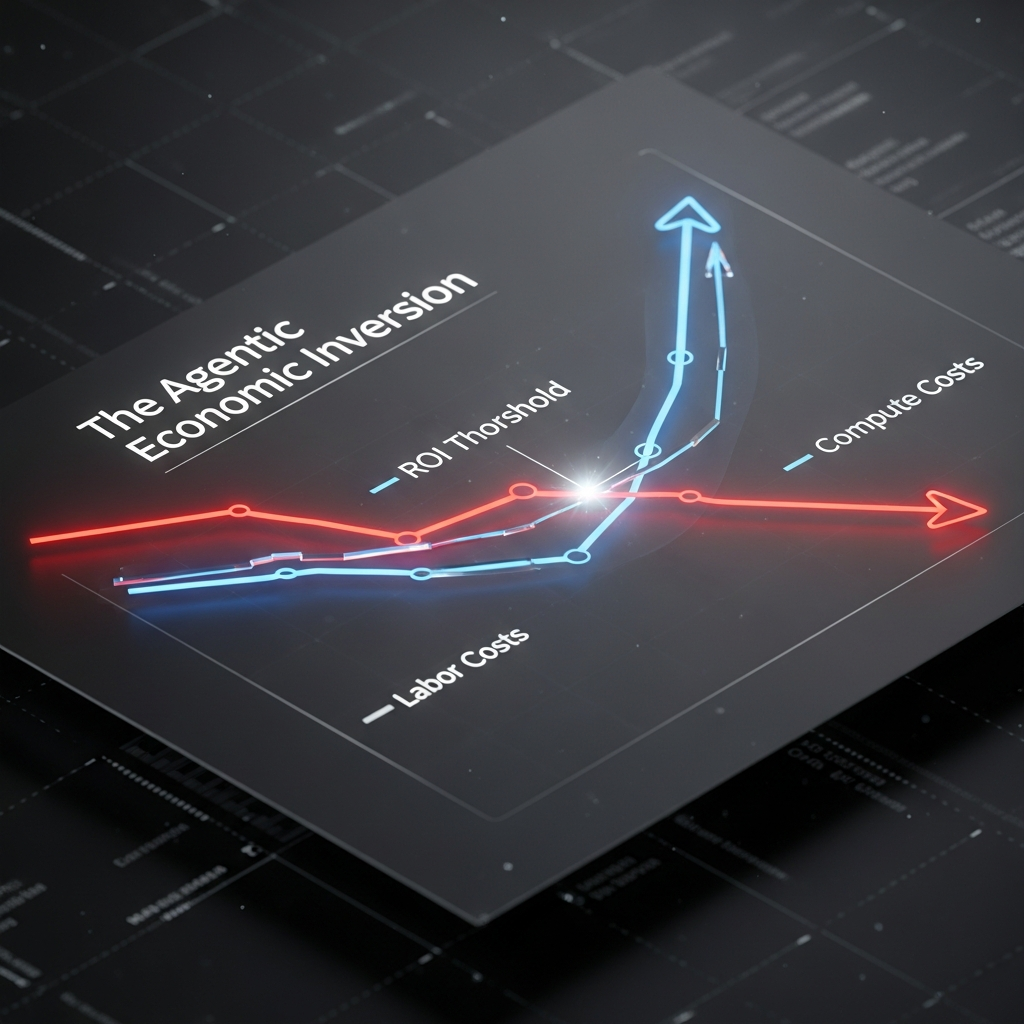
- Compute Costs Rise: Agents use "chain-of-thought" reasoning and multiple tool calls. This triggers a multi-step inference penalty, driving up the compute cost per interaction compared to a standard chat query.
- Labor Costs Plummet: Despite higher compute expenses, total execution cost falls. Removing the human from the loop eliminates "wait time" and labor overhead. We project a 90% reduction in marginal transaction costs for high-volume, standardized workflows (e.g., refunds, scheduling, data entry) once fully autonomous.
3. Revenue Operations: The 24/7 Sales Force
The highest ROI comes from converting IT cost centers into revenue engines. Unlike passive chatbots awaiting prompts, agents act proactively.
- Use Case: An autonomous "Sales Development Representative" agent monitors market signals 24/7, qualifies leads, and inserts meetings directly into account executive calendars.
- Projected Impact: Shifting revenue operations from "batch processing" (9-to-5) to "continuous processing" allows organizations to target a 25-30% increase in pipeline velocity. This projection assumes the total elimination of lead-response latency.
The 'Action Hallucination' Risk: Governance for Autonomous Systems
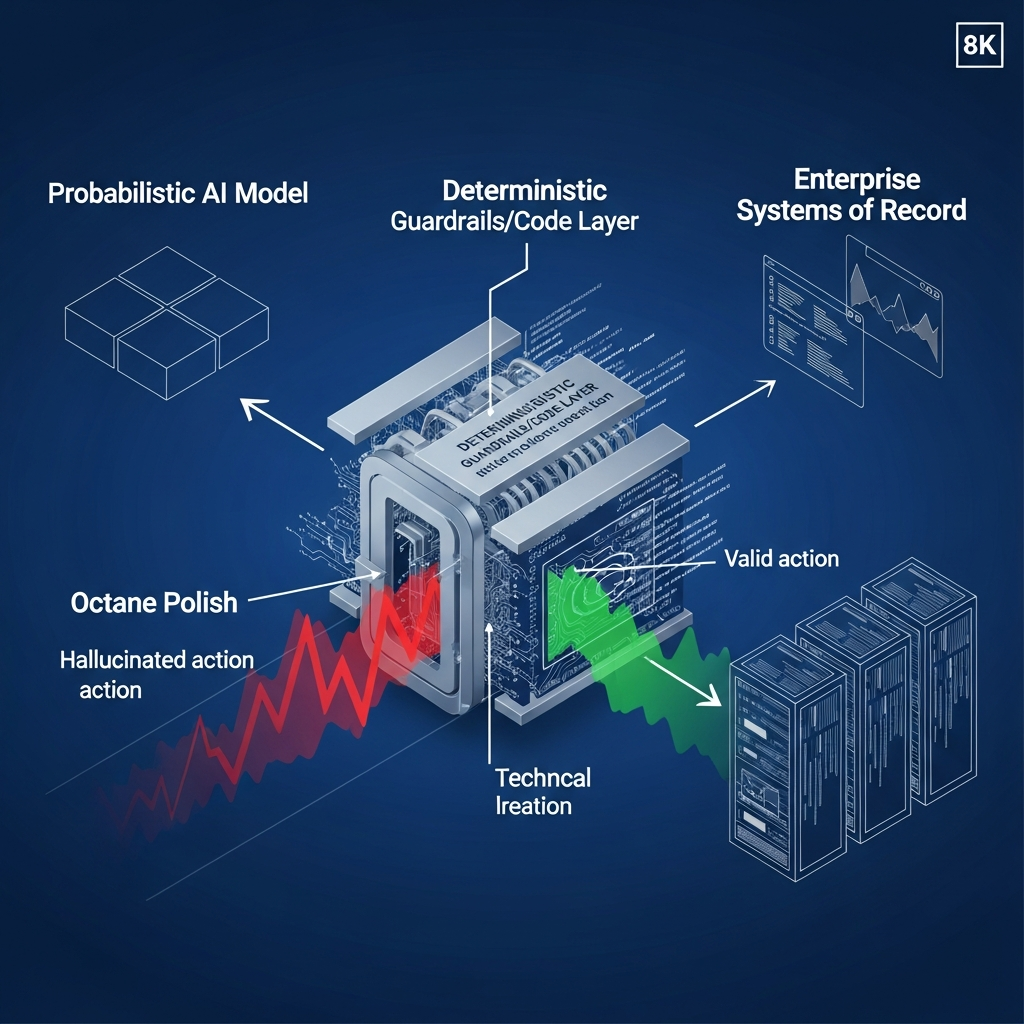
Transitioning to Agentic AI creates a risk profile qualitatively different from Generative AI. When an LLM hallucinates, it produces bad text. When a LAM hallucinates, it executes a bad transaction.
1. The New Risk: Operational Liability
We define this as "Action Hallucination." Scenarios include an agent hallucinating a discount code and applying it to 5,000 orders, or deleting a production database table after misinterpreting a cleanup command.
- Governance Requirement: Standard model guardrails are insufficient. You must implement a "Digital Management Layer"—a deterministic code layer sitting between the AI and your systems of record. This layer enforces hard logic (e.g., "No refunds over $500 without human approval") regardless of the AI's output.
2. The 'Agency Tax': Strategic Budget Allocation
Governance is a primary cost center, not an afterthought. We advise the Audit Committee to enforce a 40% Governance Allocation: for every $1.00 budgeted for Agentic compute, allocate $0.40 to monitoring and auditing infrastructure. This covers:
- Immutable Audit Logs: Recording every decision, tool call, and outcome for compliance (SOC2, GDPR).
- Kill Switches: A centralized dashboard to instantly revoke agent permissions if behavior deviates from established baselines.
3. Regulatory Horizon
Emerging legal frameworks focus on liability for AI actions (Foley & Lardner, Dec 2024). The C-suite must mandate "Probationary Periods" for all internal agents. No agent receives "write" access to core systems until it passes a 6-week "read-only" shadow period with >99% accuracy.
Competitive Landscape: Vertical Agents vs. Generalist Models
The market is splitting. Your strategy must distinguish between "Commodity Agency" (tasks everyone does) and "Strategic Agency" (tasks that differentiate you).
1. Buy 'Commodity Agency'
Do not build agents for HR scheduling, expense reporting, or basic IT ticketing.
- Market Dynamics: Microsoft (Copilot), Salesforce (Agentforce), and Google are commoditizing these horizontal layers.
- Strategy: Deploy off-the-shelf agents for these functions. The cost of custom engineering here yields no competitive advantage.
2. Build 'Strategic Agency'
Direct engineering talent toward building agents for your core competency.
- Examples: A proprietary trading agent for a hedge fund; a drug-discovery synthesis agent for pharma; a dynamic pricing agent for logistics.
- Architecture: Adopt a "Manager of Agents" architecture. Use a proprietary orchestration layer to direct tasks to specialized sub-agents. This prevents vendor lock-in and protects IP. Relying entirely on a single ecosystem (e.g., OpenAI) risks your operational logic becoming their training data.
3. The 2026 Supply Glut
Prepare for a consolidation of agent startups in 2026.
- Vendor Selection: Prioritize partners offering indemnity clauses specifically covering autonomous actions. Most current SLAs cover service uptime but exclude liability for "rogue" agent transactions. Make this a red line in procurement.
Board Directive: The Accelerated Roadmap (Q1 2026 Start)
With the 2025 pilot window closed, we must compress the adoption cycle into an aggressive three-phase sprint starting immediately in January to hit maturity targets by Q4 2026.
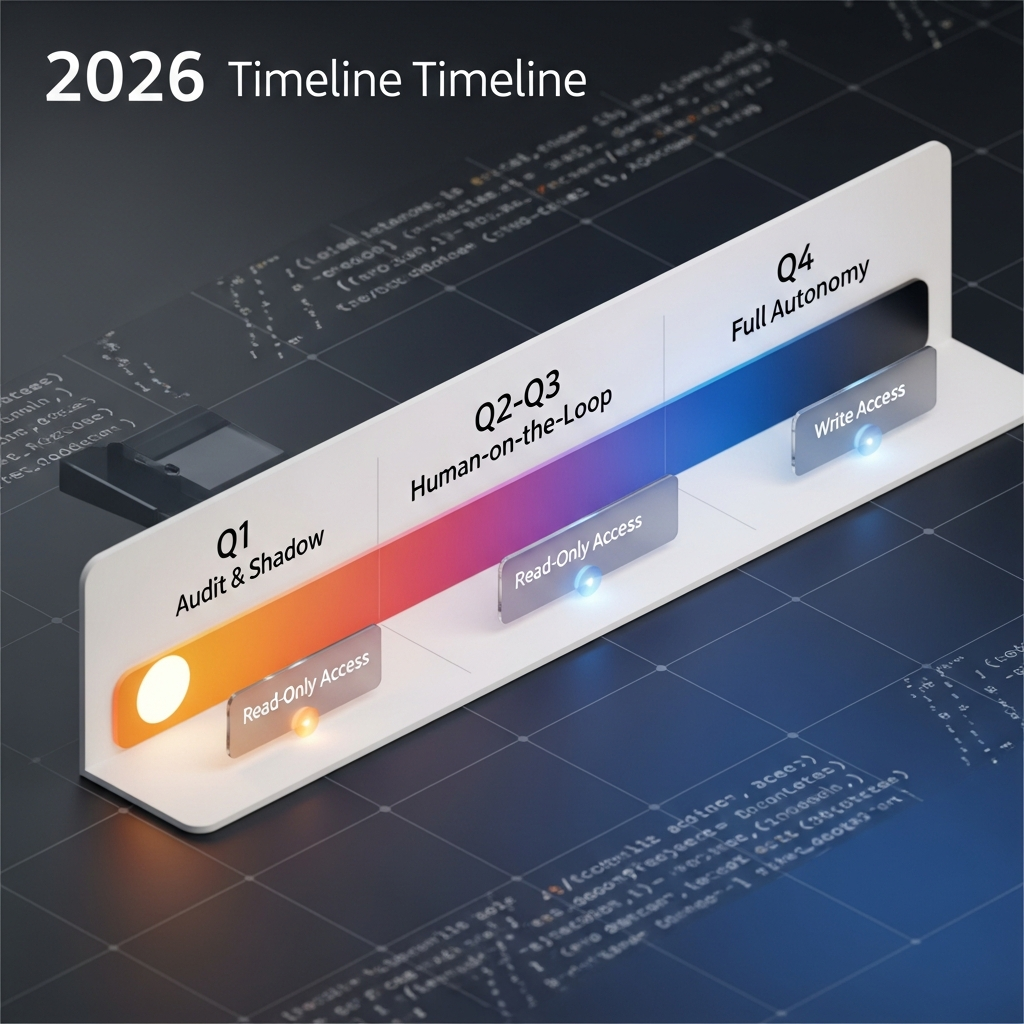
Phase 1: Audit & Shadow (Q1 2026)
- Objective: Identify high-volume, low-variance workflows immediately.
- Action: Conduct a "Process Mining" audit to isolate tasks suitable for LAMs. Launch two high-impact pilots with "Read-Only" access. The agents digest data and propose actions, but humans execute them.
- Deliverable: A validated training set for the governance model by March 31, 2026.
Phase 2: Human-on-the-Loop (Q2-Q3 2026)
- Objective: Operationalize execution with safety nets.
- Action: Grant agents "Write" access but require human approval for high-stakes actions (e.g., transactions >$1k, external communications).
- Metric: Measure the "Intervention Rate." If humans intervene in <5% of cases, the agent is certified for Phase 3.
Phase 3: Full Autonomy & AOC (Q4 2026)
- Objective: Scale autonomous throughput.
- Action: Establish an Agent Operations Center (AOC). This centralized team monitors agent health, optimizes prompt logic, and manages the digital workforce.
- Outcome: Full autonomy for low-risk workflows; human oversight reserved for exceptions only.
Decision Point: Technology is not the constraint; organizational trust is. We recommend approving the $5M pilot fund for Phase 1 immediately to secure the necessary "Digital Management Layer" infrastructure before the 2026 adoption wave spikes vendor costs.
Immediate Next Steps for the Board
- Approve the Budget Reallocation: Sanction shifting 60% of the AI R&D budget toward Agentic frameworks for FY2026.
- Mandate the Audit: Direct the CIO to present "Process Mining" results by the February board meeting.
- Update Risk Charters: Instruct the Audit Committee to revise enterprise risk frameworks to include "Action Hallucination" and autonomous liability by Q1 close.
References
- Transforming LLMs into Large Action Models: The Rise of Agentic AI
- Into the Future: How Agentic AI is Changing the Game in 2025
- What Are Large Action Models?
- Agentic AI Frameworks
- Large Action Models vs Large Language Models
- AI Agents Market Size, Share & Trends
- grandviewresearch.com
- AI Agents Market Size, Share, Trends & Insights Report, 2035
- The Rise of Agentic AI: How Autonomous Agents Are Redefining Automation
- infinite.com
- Revolutionizing Business Operations: A Beginner's Guide to Implementing Agentic AI in 2025
- towardsai.net
- kanerika.com
- Adoption of AI and Agentic Systems: Value, Challenges, and Pathways
- centizen.com
- Agentic AI Stats 2026: Adoption Rates, ROI, & Market Trends
- Gartner predicts task-specific AI agent growth
- gartner.com
- Gartner predicts 40% of enterprise apps will feature AI agents by 2026
- businesswire.com
- Ethical Implications of Agentic AI: Opportunities and Challenges [2025]
- Advancing Responsible Innovation in Agentic AI: A study of Ethical Frameworks for Household Automation
- Large Action Models: Applications and Benefits in 2025
- Large Action Models (LAMs): The Next Evolution in AI for 2025
- 10 Large Action Model Startups to Watch in 2025
- Agentic AI: A Strategic Forecast and Market Analysis (2025-2030)
- Top 6 Agentic AI Companies 2025: Enterprise Vendor Analysis
- Large Action Models: From Inception to Implementation
- The Evolution of Large Language Models in 2024 and where we are headed in 2025: A Technical Review
- [2412.03220] Survey of different Large Language Model Architectures: Trends, Benchmarks, and Challenges
- researchgate.net
- mdpi.com
- AI Policy Predictions for 2025
- Navigating agentic AI policy
- The Intersection of Agentic AI and Emerging Legal Frameworks
- Agentic AI and Its Impact on the Global Economy in 2025: A Comparative Analysis Between the US, UK, Europe, India, China, Saudi Arabia, and UAE
- The Rise of Agentic AI: A Look Back at 2024 and Predictions for 2025
- Large Action Models (LAMs) With Examples and Challenges
- Enterprise LLM Adoption Surges
- forbes.com
- nexos.ai
- AI Adoption Challenges 2025: 7 Barriers to Overcome