The 2026 Hardware Pivot: Why AI is Moving to the Edge
Architecting the Hybrid NPU-Cloud Topology: A Design Review
The Unit Economic Ceiling
Designing a system for 10 million daily active users (DAU) that relies exclusively on centralized LLM inference effectively engineers a margin ceiling that will strangle scalability.
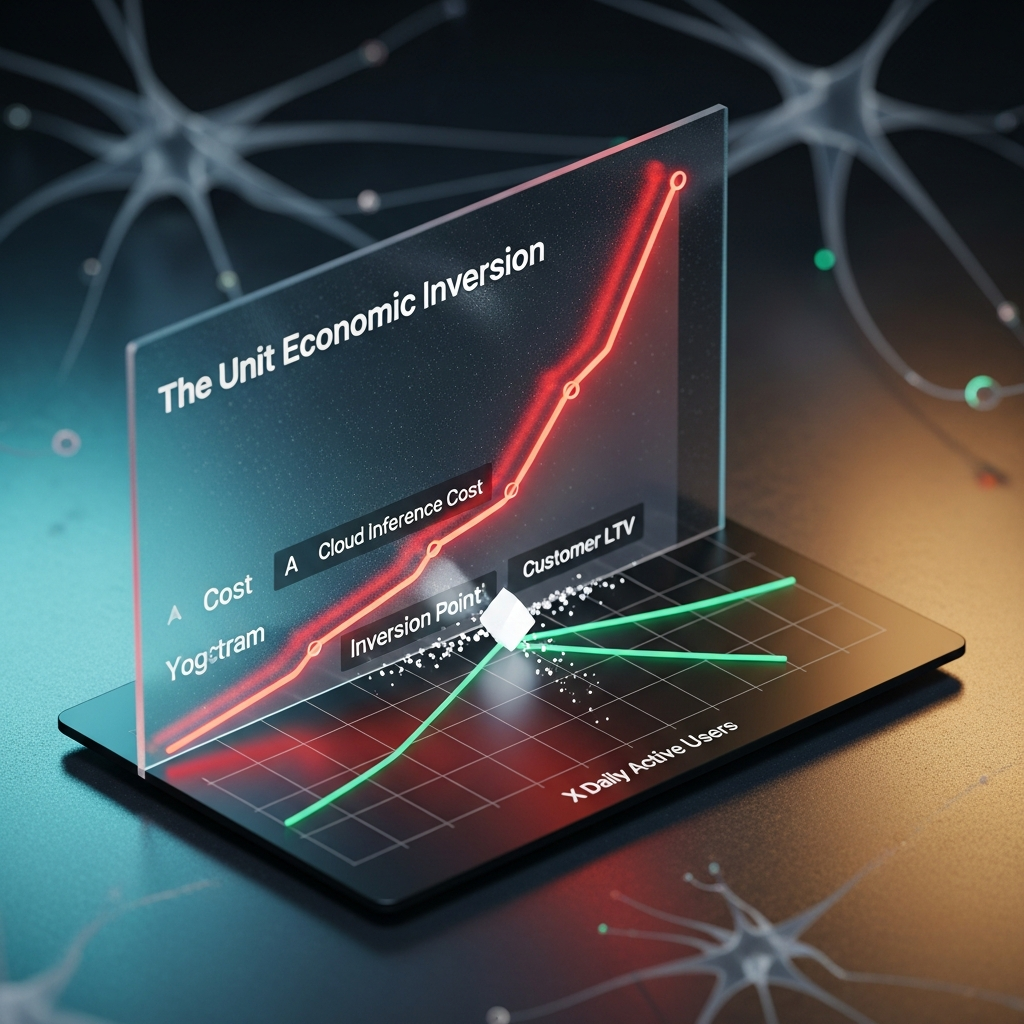
The math is stubborn. Traditional SaaS marginal costs approach zero at scale; Generative AI inference costs scale linearly with complexity. Running a GPT-4-class model for every user interaction at 10M DAU creates a unit economic inversion where compute costs exceed the customer's lifetime value (LTV).
We are hitting a saturation point in centralized inference. By 2026, the bottleneck won't be model quality—it will be the physics of latency and the economics of egress. A round-trip request to a data center, processing 500 input tokens and generating 200 output tokens, incurs a latency floor of 300-800ms. This accounts for network jitter, queueing, and tokenizer overhead before inference even starts. For real-time applications like voice agents or co-pilots, you burn your latency budget before generating a single token.
The necessary architectural pivot isn't "Cloud-First." It is "NPU-First, Cloud-Fallback."
This strategy is about margin preservation. By pushing routine tasks—summarization, classification, draft generation—to the client device, we reclaim margins. The cloud becomes the escalation path for complex reasoning, not the default handler for every keystroke.
Silicon Reality: The 2026 NPU Environment
Hardware support for this shift is maturing, but the ecosystem is messy. We are leaving the homogeneous comfort of server-side x86/CUDA for chaotic client-side heterogeneity.
Roadmaps and benchmarks suggest that by 2026, three primary architectures will dominate the client edge. Architects must distinguish between marketing's "Peak TOPS" and the operational reality of "Sustained TOPS."
- Intel Panther Lake / Nova Lake (NPU 6): Targeting 70+ TOPS (Trillions of Operations Per Second) for desktop workloads. The focus is sustained throughput, though driver stability remains a variable in non-Windows environments.
- Qualcomm Snapdragon 8 Elite (Gen 5 Architecture): Mobile-first. Marketing materials claim NPU capabilities exceeding 70-80 TOPS, but thermal constraints on mobile devices often cap sustained performance at 40-50% of peak.
- Apple Silicon (A-Series/M-Series): The walled garden. Highly optimized CoreML integration offers efficient memory usage, but remains inaccessible to standard ONNX runtimes without specific, often brittle, conversion pipelines.
The Metric That Matters: Ignore "Peak TOPS." It is a vanity metric. The only metrics relevant to a Principal Architect are TOPS/Watt and Sustained Inference per Second (IPS) under load.
A device claiming 100 TOPS that throttles after 30 seconds of video rendering is functionally useless for a sustained co-pilot session.
The Compiler Trade-off: To support this, you cannot simply "deploy Docker." You are entering a complex build environment. You will likely need to maintain build pipelines for:
- ONNX Runtime (Windows/Linux cross-compatibility)
- CoreML (Apple ecosystem optimization)
- eIQ Neutron (NXP/Embedded edge specific flows)
- TFLite (Legacy Android support)
Trade-off: You gain reduced marginal cost inference and lower latency. You lose the simplicity of a single deployment target. CI/CD complexity increases significantly, requiring rigorous device-farm testing to catch regressions on specific chipsets.
Implementation Pattern: The Hybrid Inference Controller
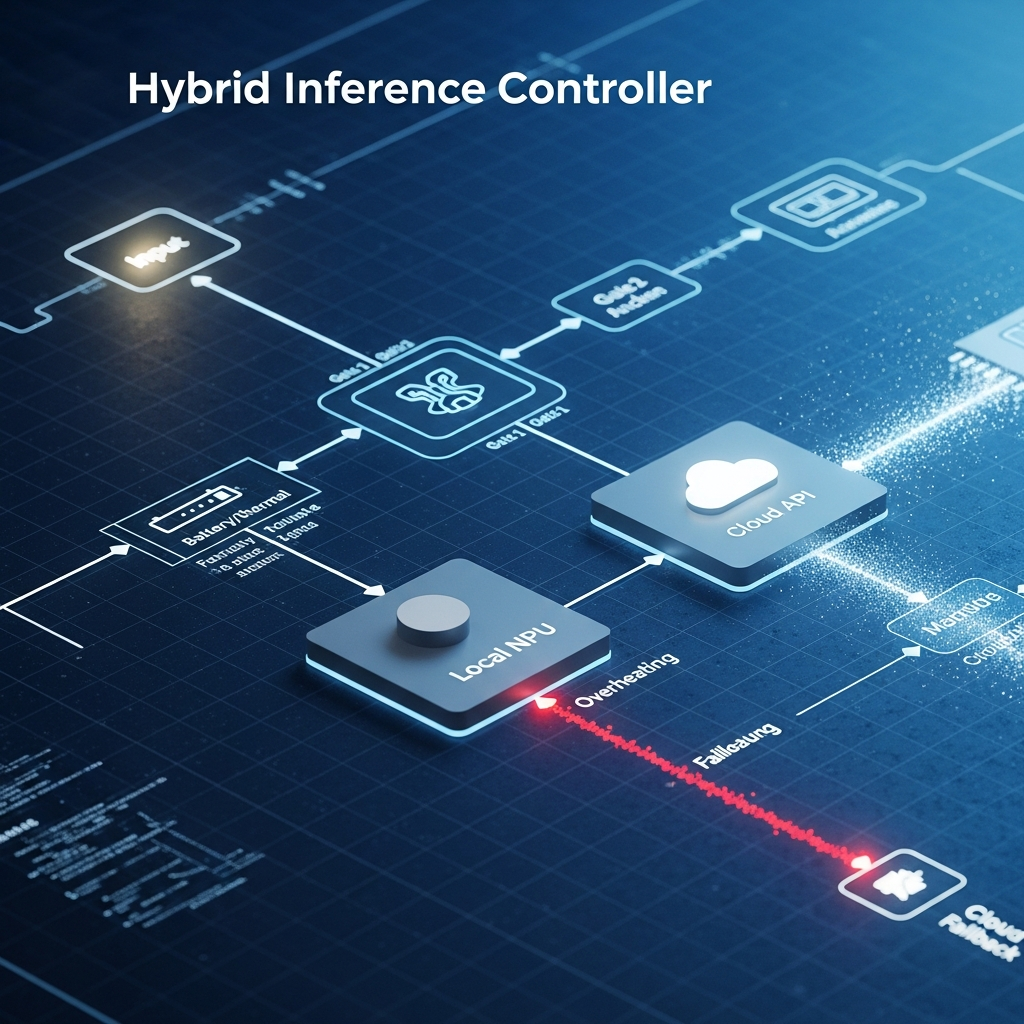
To handle this fragmentation, we use a Hybrid Inference Controller. This client-side logic layer routes requests based on device telemetry, not just model capability.
We don't ask, "Can the local model answer this?" We ask, "Can the local model answer this right now, given the battery state and thermal headroom?"
The Dynamic Routing Logic
Below is the pseudo-code logic for a production-grade router. Note the failure checks before inference is attempted.
interface DeviceTelemetry {
  batteryLevel: number;      // 0.0 to 1.0
  thermalState: 'OK' | 'THROTTLING' | 'CRITICAL';
  npuAvailability: boolean;
  networkLatency: number;    // ms to cloud endpoint
  memoryPressure: 'LOW' | 'HIGH';
}

class InferenceRouter {
  private readonly BATTERY_THRESHOLD = 0.2;
  private readonly LATENCY_SLA = 200; // ms

  async routeRequest(prompt: string, complexity: 'LOW' | 'HIGH'): Promise<InferenceResult> {
    const telemetry = await this.getDeviceTelemetry();

    // 1. Safety Circuit Breaker
    // If device is hot or memory is full, do not attempt local inference.
    // Trade-off: Increases cloud costs to preserve user device stability.
    if (telemetry.thermalState === 'CRITICAL' || telemetry.memoryPressure === 'HIGH') {
      console.warn("Device constrained. Forcing Cloud Fallback.");
      return this.callCloudLLM(prompt);
    }

    // 2. Capability Check
    if (complexity === 'HIGH') {
      // Complex reasoning (e.g., legal analysis) requires parameter counts
      // exceeding local capacity (typically >7B params).
      return this.callCloudLLM(prompt);
    }

    // 3. Operational Viability Check
    const isLowBattery = telemetry.batteryLevel < this.BATTERY_THRESHOLD;
    const isThrottled = telemetry.thermalState === 'THROTTLING';

    if (telemetry.npuAvailability && !isLowBattery && !isThrottled) {
      try {
        // Attempt local inference with SLM (Small Language Model)
        // Timeout is aggressive (1.5s) to prevent UI hangs
        return await this.callLocalSLM(prompt, { timeout: 1500 });
      } catch (e) {
        // Local failure (OOM, Driver crash, Timeout) -> Fallback
        // Log this specifically to separate model failure from system failure
        this.logMetric("local_inference_failure", e);
        return this.callCloudLLM(prompt);
      }
    }

    // Default to cloud if local conditions are poor
    return this.callCloudLLM(prompt);
  }
}
Speculative Decoding (Draft and Verify)
A strong pattern for 2026 architectures is Speculative Decoding (often called Device-Server Collaborative inference, or DiSCo). The local NPU "drafts" the response—generating tokens fast but with lower accuracy—and the Cloud LLM "verifies" or corrects the tokens in parallel.
- Benefit: Research shows this reduces cloud compute load significantly (the cloud model only processes corrections) and lowers perceived latency.
- Cost: Increases client-side memory footprint. This is likely not viable for older devices with <8GB RAM, as loading even a quantized draft model consumes 2-4GB of resident memory.
The Turn: Thermal Throttling is the New Network Latency
In cloud architecture, we obsess over network latency (P99). In Edge AI, the enemy is Thermal Throttling.
Performance on the edge is non-deterministic. A user running your app on a cool laptop in an AC-controlled office gets 50 tokens/sec. The same user, sitting in direct sunlight or compiling code in the background, might drop to 10 tokens/sec.

The Failure Mode: When the NPU throttles, it doesn't just slow down; it often causes application layer timeouts. If your timeout is set to 2 seconds, and the throttled NPU takes 2.5 seconds, the request fails. If you auto-retry to the cloud, you create a "Thundering Herd" effect exactly when your users are experiencing local performance degradation.
Distributed Drift:
Unlike a server model where v1.2 is identical on every node, edge models drift.
- User A has an outdated GPU driver.
- User B has a specific NPU instruction set extension disabled.
- User C is running on a constrained memory partition.
The same prompt yields different latencies and occasionally different outputs across these devices. Debugging this requires a shift in observability.
Observability Strategy: You must implement Client-Side Tracing. Server logs are useless for local inference failures. You need OpenTelemetry collectors running inside the client application, sampling inference events (input token count, time-to-first-token, thermal state) and batch-sending them to your backend.
Production Readiness: Migration and Sovereignty
The Compliance Advantage
The EU AI Act and GDPR data sovereignty requirements become manageable with this architecture. By keeping PII (Personally Identifiable Information) processing on the local NPU, you minimize the data footprint requiring complex processing agreements.
- Strategy: Tag data fields as
LOCAL_ONLY. The router enforces that prompts containing these tags never hit the cloud endpoint, returning an error if the local NPU is unavailable, rather than leaking data.
The Migration Path: Fallback-First
Do not attempt a "Big Bang" switch to local inference. A phased approach reduces risk:
- Phase 1 (Shadow Mode): Run local SLMs in the background. Discard the result. Log the latency, accuracy (compared to cloud), and thermal impact.
- Phase 2 (Hybrid-Draft): Use local models for "drafting" text in UI inputs, with a user-triggered "Enhance with Cloud" button.
- Phase 3 (Router Enforcement): Enable the
InferenceRouterto block cloud calls for low-complexity tasks.
The Shift in Skills
The transition to Edge AI isn't about buying new servers; it's about re-skilling your backend team. They must stop thinking in terms of Kubernetes pods and start thinking in terms of thermal envelopes and instruction sets.
We are moving from a centralized monolith to a federated fleet of 10 million unreliable, battery-powered accelerators. Architects who respect the physics of this environment will ship performant systems. Those who treat the edge like "just another server" will drown in support tickets and unpredictable cloud bills.
Recommended Next Steps
- Audit your prompt logs: Categorize requests by complexity. If a significant portion (e.g., >40%) are simple summarization/classification, you are a candidate for this topology.
- Prototype the Router: Build the
InferenceRouterlogic before you have the models. Test the fallback mechanisms under simulated network/thermal stress. - Evaluate SLMs: Begin benchmarking 3B-7B parameter models (e.g., Llama, Phi) on consumer hardware to establish a baseline for "acceptable" local latency.
References
- [2509.14388] eIQ Neutron: Redefining Edge-AI Inference with Integrated NPU and Compiler Innovations
- Coral NPU: A full-stack platform for Edge AI
- researchgate.net
- Optimizing Edge AI: A Comprehensive Survey on Data, Model, and System Strategies
- computer.org
- gartner.com
- cloverinfotech.com
- eeworld.com.cn
- Gartner predicts AI-enabled PCs to reach 43% of market by 2025
- AI PCs will ‘become the norm’ by 2029 as enterprise and consumer demand surges
- androidheadlines.com
- Qualcomm's Snapdragon 8 Elite Gen 5 Chip Will Boost AI in 2026's Most Powerful Phones
- Snapdragon 8 Elite Gen 5: Benchmark for New Flagship Phones?
- The Silent Revolution: How Local NPUs Are Moving the AI Brain from the Cloud to Your Pocket
- MediaTek's Next Chip Will Boost Low-Power AI in Next Year's Top Android Phones
- Edge vs. cloud TCO: The strategic tipping point for AI inference
- Edge vs Cloud in 2025: Why AI Needs Compute Closer to the Source
- IDC: global edge computing spending to approach $380bn by 2028
- IDC Estimates Global Spending on Edge Computing to Grow at 13.8% Reaching Nearly $380 Billion by 2028
- The AI Shadow War: SaaS vs. Edge Computing Architectures
- Intel "Nova Lake" NPU 6 Delivers 74 TOPS for Desktop AI PCs
- Intel Nova Lake CPUs Bring New Architecture & Software Upgrades, First Panther Lake SKUs This Year, 18A To Cover At least Next-Three Client & Server Products
- Intel Debuts 18A Chips With Panther Lake CPUs for Laptops
- Intel Unveils Panther Lake Architecture: First AI PC Platform Built on 18A :: Intel Corporation (INTC)
- Latest Intel CPU 2025: Performance & Roadmap Insights
- VeriSilicon and Google Jointly Launch Open-Source Coral NPU IP
- GPT-5.1 for Ambient Computing: Disruption Predictions and Strategic Playbook 2025
- Google Coral NPU: Full-Stack Platform for Edge AI
- github.io
- [Quick Review] DiSCo: Device-Server Collaborative LLM-Based Text Streaming Services
- Gemini 3 On-Device: Multimodal AI Disruption and Market Forecast 2025–2035
- medium.com
- Apple's next-gen iPhone 18 has new A20 Pro and A20 processors, codenames revealed for 2nm SoC
- 2nm Phone Chips Are Coming… And They’re INSANE (A20, Snapdragon 8 Elite Gen 6, Dimensity 9600)
- NVIDIA Jetson AGX Thor vs AGX Orin
- EU AI Act Compliance Timeline: Key Dates for 2025-2027 by Risk Tier
- The EU AI Act’s Implementation Timeline: Key Milestones for Enforcement
- EU AI Act 2025 Update: GPAI Rules & Compliance
- A comprehensive EU AI Act Summary [August 2025 update]
- European Union: EU AI Act published
- AI & LLMs on Network Edge Devices
- 5 Multi-Agent Orchestration Patterns You MUST Know in 2025!
- researchgate.net
- Draft NIST Guidelines Rethink Cybersecurity for the AI Era
- Azure Local, IoT Operations Get AI-Powered Edge Computing Enhancements -- Redmondmag.com