Agentic AI Governance: Orchestrating the 1,000+ Bot Ecosystem
Beyond the Demo: Architecting the Governance Hypervisor for the 1,000-Agent Enterprise

IDC projects Agentic AI will consume over 26% of worldwide IT spending by 2029. Gartner counters with a grimmer reality: over 40% of these projects will be canceled by the end of 2027.
This isn't a market correction. It’s an architectural indictment. We are forcing a collision between probabilistic software (LLMs) and deterministic infrastructure (databases, payment gateways).
In 2024, security teams obsessed over prompt injection. By 2025, with enterprise ecosystems scaling past 1,000 agents, the actual threat is transactional drift. We are deploying non-deterministic actors authorized to provision infrastructure and consume APIs autonomously.
For the Principal Architect, "accuracy" is a vanity metric. The only metric that matters is "containment." If you cannot mathematically prove the boundaries of an agent's execution, that system is a liability. This article details the "Governance Hypervisor" pattern—the architectural difference between a demo and a survivable production system.
The Autonomy Paradox: Latency vs. Survivability
Marketing materials promise "set it and forget it" autonomy. Operational reality proves that autonomy scales linearly with risk. Moving from a single RAG pipeline to a multi-agent ecosystem makes manual log auditing impossible.
The "Governance-as-a-Service" framework (arXiv 2508.18765) highlights a fatal gap in standard enterprise stacks: we lack a control plane for intent. Traditional API gateways throttle based on volume (QPS) or identity (JWTs). They have no mechanism to throttle based on semantic drift or logic errors.
The Architectural Trade-off
Deploying agents at scale forces a hard choice: Latency or Survivability.

A governance layer imposes a "tax" on every agent interaction—typically 50ms to 200ms depending on policy complexity.
- Without Governance: Agents execute at the speed of the LLM and network (~400ms per step). The risk of cascading failure is unmanaged.
- With Governance: Execution slows to ~600ms per step. In exchange, you intercept malformed intent before it hits the database.
In a system handling 10M requests/day, this latency overhead is heavy. It is also the only thing preventing massive data corruption.
Topology: The Hierarchical Mesh
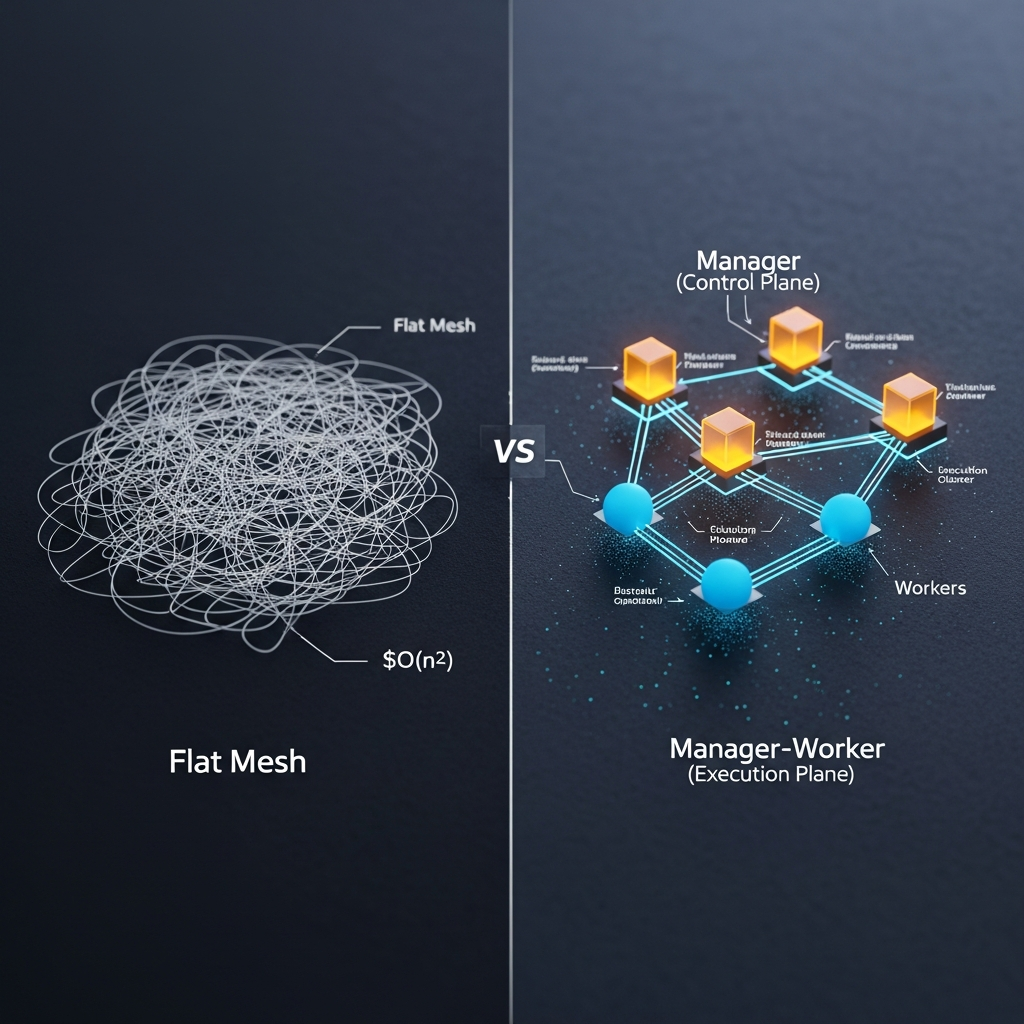
Early "flat" agent swarms—where every agent has peer-to-peer communication rights—fail under load. As the agent count ($n$) rises, communication overhead explodes quadratically ($O(n^2)$), and context windows fill with irrelevant cross-talk.
Research on "Hierarchical Decentralized Multi-Agent Coordination" (arXiv 2512.00614) confirms that partitioning agents into Manager-Worker clusters drastically reduces resource contention and hallucination rates.
The Pattern: Strict Hierarchy
Abandon the chaotic mesh. Implement a strict hierarchy:
- Manager Agents: Stateful actors. They maintain the execution plan, hold transaction "memory," and enforce scope. They never execute external tools directly.
- Worker Agents: Stateless, ephemeral, single-purpose. They execute one tool (e.g.,
run_sql_query,fetch_weather) and terminate.
Implementation: Network-Level Isolation
Agents will not respect these boundaries voluntarily. Enforce them at the network level using Kubernetes NetworkPolicies or Service Mesh configurations.
# Network Policy: Hierarchical Isolation
# Prevents Worker agents from communicating with anything
# except their specific Manager and the whitelisted Tool API.
apiVersion: networking.k8s.io/v1
kind: NetworkPolicy
metadata:
  name: worker-isolation
spec:
  podSelector:
    matchLabels:
      role: worker-agent
  policyTypes:
  - Ingress
  - Egress
  ingress:
  - from:
    - podSelector:
        matchLabels:
          role: manager-agent
    # Workers accept traffic ONLY from Managers
  egress:
  - to:
    - ipBlock:
        cidr: 10.20.0.0/16 # Whitelisted Internal Tool APIs
    # Workers cannot talk to other agents or the public internet
Operational Impact: This topology isolates failure domains. If a Worker agent enters a hallucination loop or hangs, the Manager detects the timeout (>5000ms) and kills the pod. The transaction state remains safe within the Manager, allowing for a clean retry or graceful degradation.
Failure Modes: The Hallucination Cascade
In deterministic systems, exponential backoff resolves transient network errors. In agentic chains, a blind retry compounds semantic errors.
Analysis from Galileo.ai and the "Why Multi-Agent AI Systems Fail" report identifies error propagation as a primary killer. Consider this scenario: Agent A hallucinates a file path. Agent B (the code executor) receives this path. If Agent B functions "correctly," it attempts to write to that non-existent path, triggering an exception or overwriting valid data. This is the Hallucination Cascade.
The Fix: Semantic Circuit Breakers
Standard circuit breakers (Hystrix, Resilience4j) trip on latency or HTTP 5xx errors. Agentic systems require Semantic Circuit Breakers that trip on structure and policy violation.
You must inject deterministic validation steps between agent nodes.
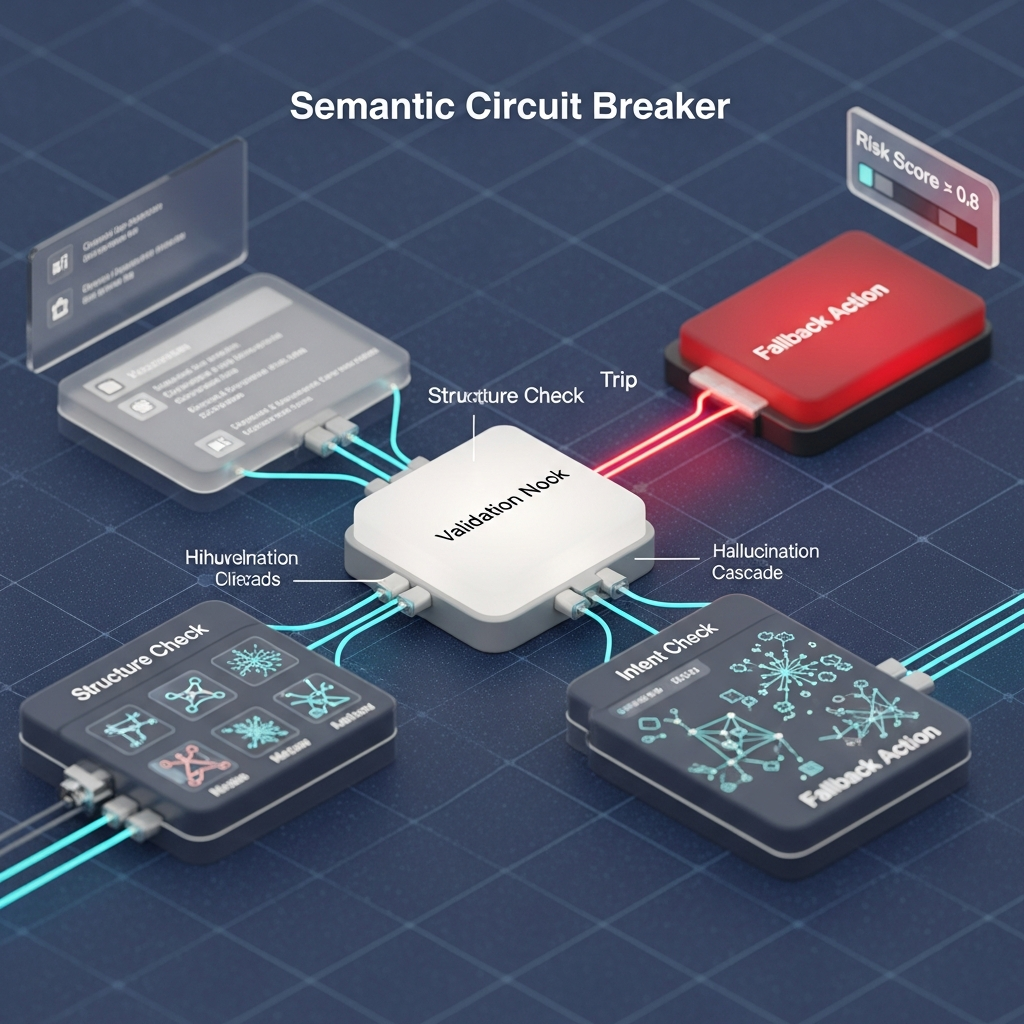
Pseudo-code Logic:
class SemanticBreaker:
    def __init__(self, schema_validator, policy_engine):
        self.schema = schema_validator
        self.policy = policy_engine
        self.failure_count = 0

    def execute_step(self, agent_output, context):
        # 1. Structural Validation (JSON Schema)
        # Fail fast if the agent didn't return valid JSON
        if not self.schema.validate(agent_output):
            self.metrics.increment("structural_failure")
            raise StructuralViolationError("Invalid JSON structure")

        # 2. Semantic Validation (Deterministic Guardrails)
        # Check intent against business rules (Policy-as-Code)
        risk_score = self.policy.evaluate(
            action=agent_output.action,
            resource=agent_output.target,
            user_context=context
        )

        # If risk is high, trip the breaker
        if risk_score > 0.8:
            self.metrics.increment("semantic_breaker_tripped")
            return FallbackAction(
                reason="Unsafe Intent Detected",
                details=f"Risk score {risk_score} exceeds threshold"
            )

        return downstream_agent.process(agent_output)
Relying on a downstream agent to "figure it out" bets database integrity on a probabilistic roll. Don't take that bet.
The Governance Hypervisor: Beyond RBAC
Static Role-Based Access Control (RBAC) fails with autonomous agents. RBAC asks: "Is this user allowed to call POST /refund?"
Agentic governance must ask: "Is this agent allowed to issue a refund of this amount, for this reason, given the current budget context?"
This demands a Governance Hypervisor. As proposed in the "Governance-as-a-Service" research (arXiv 2508.18765), this architectural layer sits between the agent and the execution environment. It intercepts intent before it becomes action.
Key Capabilities
- Financial Quotas: Token limits are useless here. The Hypervisor enforces financial impact limits (e.g., "Agent X cannot spend more than $500/day on cloud resources" or "Refunds capped at $50 per transaction").
- Confidence-Based Routing: If the agent's internal confidence score drops below a threshold (e.g., < 0.85), the Hypervisor pauses execution and routes the context to a human reviewer.
- Policy-as-Code: Rules are defined in languages like Rego (Open Policy Agent), not embedded in the agent's system prompt.
Implication: Move safety logic out of the prompt. Prompts are suggestions; the Hypervisor is law.
Migration Strategy: The Semantic Strangler Pattern
Most enterprises run on decades of legacy Java/Spring applications. Exposing these directly to an LLM via Swagger/OpenAPI is reckless. The LLM lacks the historical context to understand implicit business logic (e.g., "Don't call updateCustomer without calling lockRecord first").
The Strategy
Adopt the Semantic Strangler—a variation of the Strangler Fig pattern. Never allow agents to access raw APIs. Build a Semantic Gateway using protocols like the Model Context Protocol (MCP).
Case Evidence: Initiatives like Microsoft’s Open Agentic Web and JPMorgan’s multi-agent research show that standardized communication protocols are essential for scale. They expose skills, not endpoints.
The Semantic Wrapper Implementation
- Legacy API:
POST /api/v1/transfer(Complex, requires 4 headers, strict payload, specific sequence). - Semantic Interface (MCP):
transfer_funds(amount, recipient)(Simple, strongly typed, intent-focused). - The Glue: Middleware handles orchestration (auth, retries, header injection, sequence enforcement). The agent focuses solely on parameter generation.
This limits the blast radius. The agent can only execute what the Semantic Interface exposes. When the legacy system changes, you update the wrapper, not the agent's prompt.
Operational Reality: Observability
Debugging a non-deterministic system requires more than standard logging. When a user reports "the agent bought the wrong ticket," a stack trace tells you nothing. You need to trace the reasoning chain.

Observability Requirements:
- Distributed Tracing: Use OpenTelemetry to trace the request from User -> Manager -> Worker -> Tool -> Database.
- State Snapshots: Capture the agent's context window at every decision point.
- Cost Attribution: Tag every LLM call with a
transaction_idto correlate specific user requests with token costs.
Synthesis
The "1,000-Agent Enterprise" isn't a scale problem; it's a control problem. Building flat topologies, relying on prompt engineering for safety, and exposing raw APIs guarantees you will join the 40% failure statistic predicted by Gartner.
Strategic Options for Architects:
- Evaluate Topology: Move from flat meshes to Manager-Worker hierarchies to isolate context and failure domains.
- Implement the Hypervisor: Deploy a policy interception layer (using OPA or similar) that validates intent, not just identity.
- Abstract the Monolith: Use semantic interfaces (like MCP) to wrap legacy systems. Ensure agents interact with safe abstractions rather than raw APIs.
We are past the demo phase. Architect for the reality of failure.
References
- Governance-as-a-Service: A Multi-Agent Framework for AI System Compliance and Policy Enforcement
- A Multi-Agent Generative AI Framework for Automated Data Engineering, Governance, and Analytical Optimization | International Journal of AI, BigData, Computational and Management Studies
- arxiv.org
- AI Agent Orchestration: Multi-Agent Systems That Actually Work in 2025
- Top AI Agent Orchestration Frameworks for Developers 2025
- hpcwire.com
- Agentic AI to Dominate IT Budget Expansion Over Next Five Years, Exceeding 26% of Worldwide IT Spending, and $1.3 Trillion in 2029, According to IDC
- gartner.com
- Gartner’s Top Tech Trends 2025: AI Governance on the Rise
- Gartners Top Strategic Technology Trends For 2025
- Gartner Top 10 Strategic Technology Trend 2025: Agentic AI
- Autonomous Agents: Bold Disruption Predictions and Market Forecast 2025
- ISO/IEC 42001:2023 Artificial Intelligence Management System (AIMS): A Comprehensive Guide
- AgentNet++: Scalable Multi-Agent Framework
- researchgate.net
- [2512.00614] Hierarchical Decentralized Multi-Agent Coordination with Privacy-Preserving Knowledge Sharing: Extending AgentNet for Scalable Autonomous Systems
- Hierarchical Decentralized Multi-Agent Coordination with Privacy-Preserving Knowledge Sharing: Extending AgentNet for Scalable Autonomous Systems
- orcid.org
- Why Multi-Agent AI Systems Fail and How to Fix Them
- medium.com
- Best AI Agent Evaluation Benchmarks: 2025 Complete Guide
- Context-Bench
- Introducing FHIR-AgentBench
- Case Study: How JPMorgan Chase is Revolutionizing Banking Through AI
- 🛟 JPMorgan’s Dimon Deploys Multi-Agentic AI at Scale
- HR Business Partner Competencies for the AI Workplace
- Agentic AI Use Cases That Prove the Power of Agentic AI
- AI Agent Ecosystem: A Guide to MCP, A2A, and Agent Communication Protocols
- Governance and Control: How to Stop Agentic AI Tools 2025
- [2504.11501] A Framework for the Private Governance of Frontier Artificial Intelligence
- Securing Autonomous AI Agents: A Complete Governance Checklist
- papercept.net
- What is Plugged in? The AI Control Plane for Knowledge & Tools
- EU AI Act Update 2025
- Nelson Mullins
- EU AI Act: European Commission Publishes General-Purpose AI Code of Practice
- OECD AI Policy Observatory Portal
- European Union publishes its General-Purpose AI Code of Practice
- State of Enterprise AI 2025
- 39 Agentic AI Statistics Every GTM Leader Should Know in 2025
- stelia.ai
- Top Agentic AI Statistics 2025
- AI Agent Cost Per Month 2025: Real Pricing Revealed
- Microsoft Build 2025: The age of AI agents and building the open agentic web
- The Best AI Agent Resources You Should Know in 2025
- Telemetry Strategies for Distributed Tracing in AI Agents
- Strangler Pattern: How to Migrate from Legacy Systems Incrementally
- AI-powered Legacy Modernization
- Replacing Legacy Systems, One Step at a Time with Data Streaming: The Strangler Fig Approach