The AI Energy Debt: Strategies for the 2026 Compute Crunch
Energy Strategy as the New Compute Constraint: Navigating the 2026-2027 Capacity Gap

Strategic Analysis for the C-Suite
Executive Summary: The Shift from Silicon to Electrons
Silicon availability no longer dictates the pace of Artificial Intelligence scaling. As GPU supply chains stabilize, energy availability has emerged as the primary bottleneck. By 2027, power shortages will operationally restrict 40% of AI data centers [1].
This shift creates a tangible capital risk for Fortune 500 enterprises: "stranded assets." High-value compute infrastructure faces underutilization not because of software bugs or hardware deficits, but due to utility interconnect delays that now exceed 36 months in key markets. While hardware efficiency improves, aggregate demand will climb sharply through the 2025-2026 window [2].
Organizations viewing power acquisition as a back-office procurement function face operational ceilings that will cap revenue growth. Conversely, integrating energy strategy into the technology roadmap—treating power access as a competitive moat—secures scaling velocity as grid constraints tighten.
The 'Reasoning' Multiplier: Re-evaluating Demand Forecasts
Conclusion: Energy models built on 2023-era Large Language Model (LLM) query patterns will fail. The transition to "Agentic AI" creates a multiplier effect on energy intensity per transaction.
Current corporate forecasts often assume linear growth based on single-shot inference—input a prompt, receive an answer. The industry, however, is pivoting to agentic workflows. These systems employ complex reasoning loops, self-correction, and multi-step task execution to solve problems rather than merely retrieving information.
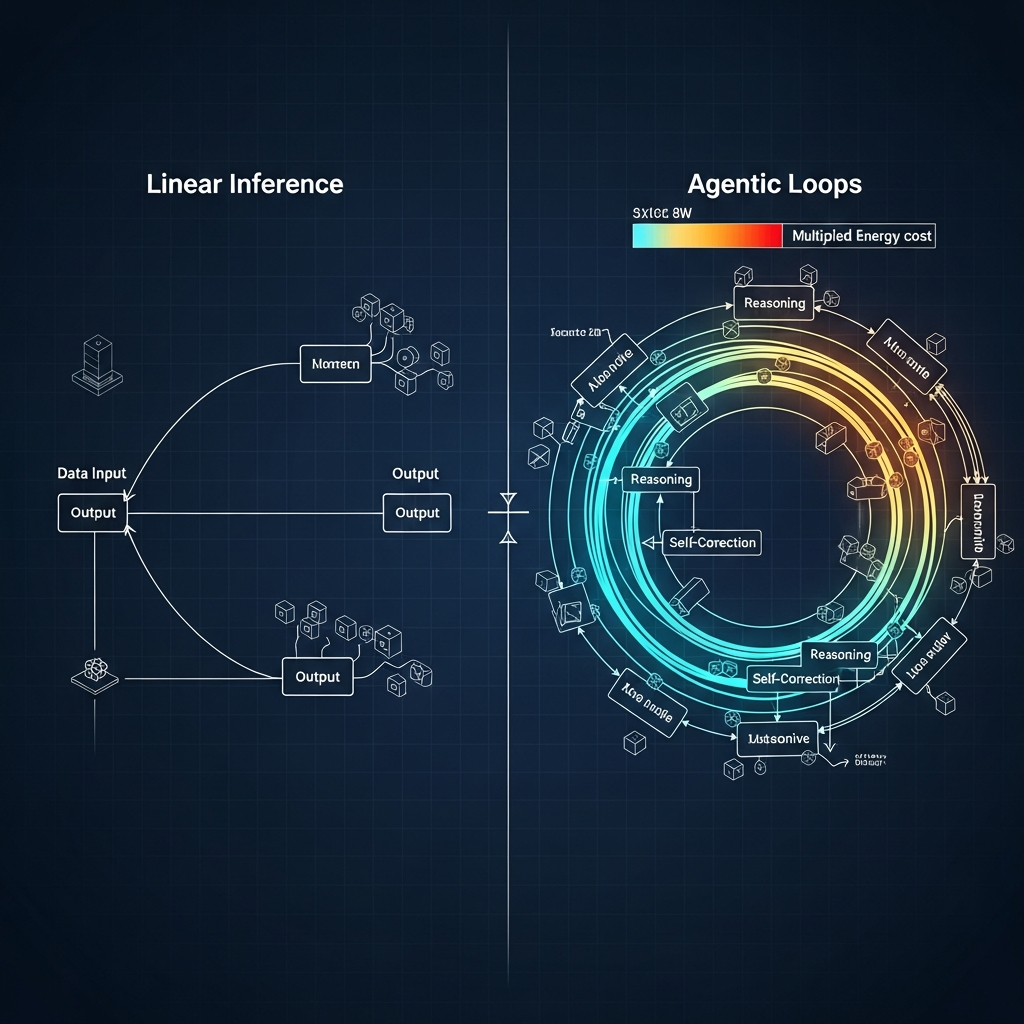
This architectural pivot fundamentally changes the energy profile. Unlike a single-shot query, an agentic workflow may trigger dozens of internal inference steps to generate one user-facing output. Research confirms that reasoning-heavy models are significantly more computationally intensive per task than their predecessors [3].
Testing reveals that while these models deliver superior problem-solving, they carry a substantially higher "energy price tag" per transaction [4].
Strategic Implication: As enterprises deploy agentic capabilities to drive revenue, OpEx models based on historical inference costs will prove inaccurate. Without updated forecasting that factors in this "reasoning multiplier," organizations risk underestimating 2026 energy requirements. This variance leads directly to budget overruns or forced service throttling during peak demand.
The Efficiency Paradox: Why Hardware Upgrades May Not Lower Bills
Conclusion: Banking on next-generation hardware efficiency to flatten the energy curve is a failed strategy. Historical data shows efficiency gains drive increased utilization, not net energy reduction.
A prevalent assumption is that next-generation hardware will offset rising compute demand. Architectures like Nvidia’s Rubin and AMD’s MI400 are engineered for massive performance-per-watt improvements. AMD’s roadmap targets significant efficiency leaps to challenge market dominance [5]. Similarly, Nvidia’s Rubin architecture focuses on massive-context inference efficiency [6].

These engineering achievements, however, operate within the Jevons paradox: increasing the efficiency of a resource leads to higher total consumption. Lower unit costs for inference incentivize engineering teams to run larger models, process vaster datasets, and deploy AI into more complex applications.
Efficiency gains function as a mechanism for increasing capability, not for reducing aggregate power load. Planning for a net increase in megawatt requirements is the only prudent baseline. While this enables greater computational throughput, it does nothing to alleviate pressure on physical grid connections.
Sourcing Strategy: Beyond the Public Grid
Conclusion: With utility interconnect delays extending 3-5 years in saturated markets like Northern Virginia, leaders must evaluate alternative sourcing. Grid connection remains the standard, but it is no longer the sole path for high-availability compute.
1. Behind-the-Meter (BTM) Generation
Co-locating data centers with power generation assets allows facilities to bypass public grid transmission bottlenecks. This "energy sovereignty" approach eliminates reliance on municipal utility timelines [7].
- Trade-off: BTM solutions offer speed-to-market but require higher upfront CapEx and introduce complex regulatory compliance regarding local emissions and fuel sourcing.
2. The Geothermal and Nuclear Split
Small Modular Reactors (SMRs) are often touted as a solution, yet deployment at scale is a 2030+ timeline due to regulatory and construction lead times [8].
For the 2026-2027 window, enhanced geothermal systems offer a viable source of firm, clean baseload power. Market leaders like Meta are securing partnerships here to support near-term capacity [9].
- Trade-off: Geothermal is location-dependent, requiring compute infrastructure to move to the energy source rather than bringing energy to the data center.
3. Geographic Diversification
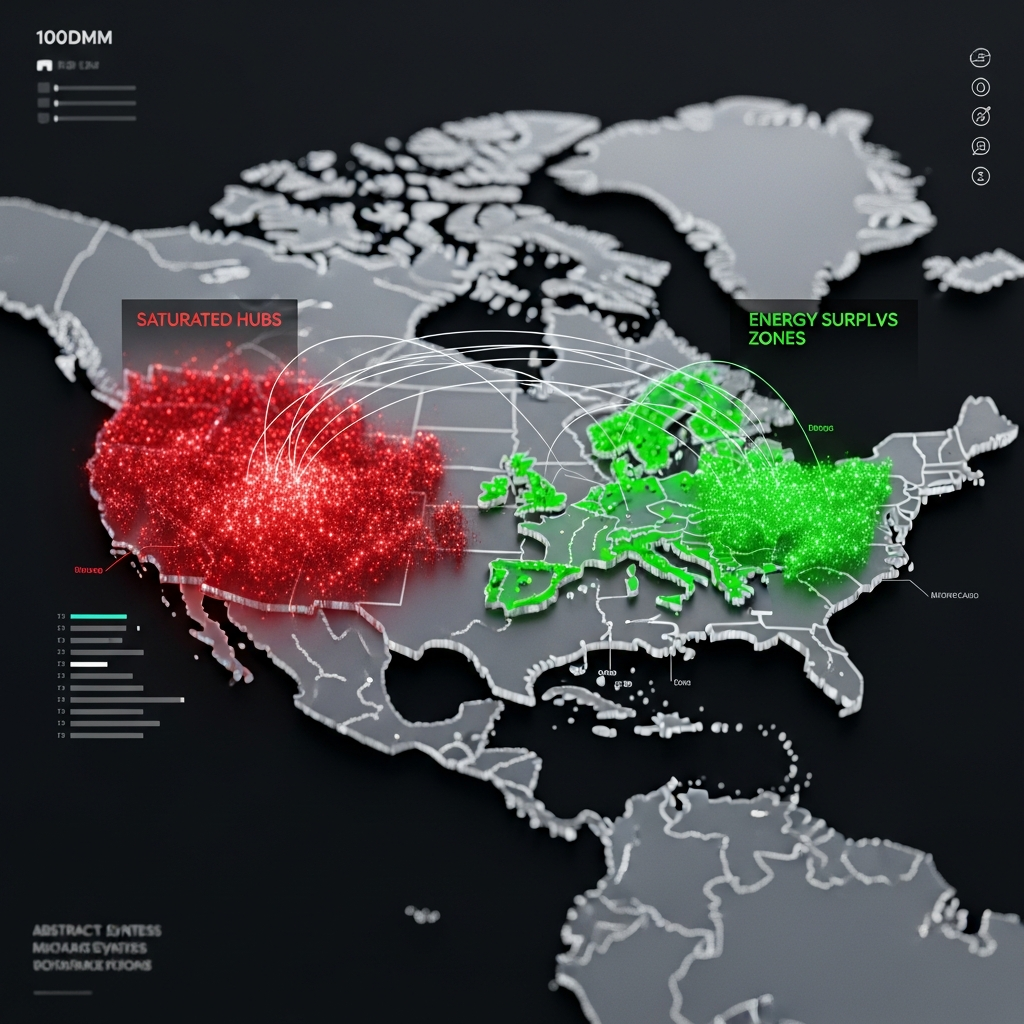
Strategies now favor distributing inference workloads to regions with energy surpluses (e.g., the Nordics or specific U.S. zones) rather than clustering in major hubs.
- Trade-off: While this prioritizes operational reliability, it introduces latency considerations. Organizations must distinguish between latency-sensitive "hot" storage/inference and latency-tolerant "warm" workloads [10].
Regulatory Context: Efficiency as Market Access
Conclusion: Regulatory frameworks in key markets are hardening from voluntary guidelines to mandatory compliance standards. Inefficiency is becoming a "market access" risk.
- European Union: The AI Act and Energy Efficiency Directive are establishing reporting mandates. Non-compliance by 2026 will result in financial penalties or operational restrictions [11]. Energy efficiency is transforming from a sustainability metric into a legal requirement for doing business in the EU.
- China: The Ministry of Industry and Information Technology (MIIT) enforces strict Power Usage Effectiveness (PUE) caps. These regulations create a barrier to entry for inefficient compute infrastructure in the world's second-largest economy [12].
For global enterprises, energy efficiency has graduated from Corporate Social Responsibility (CSR) to a license to operate.
Strategic Options for the C-Suite
To navigate the projected capacity gap, executives should apply the following evaluation framework to hedge against volatility.
1. Audit 'AI Energy Debt'
- Action: Re-model the organization's AI roadmap to account for the "reasoning multiplier" of agentic workflows.
- Goal: Identify deficits between contracted power capacity and projected compute intensity.
- Impact: If the roadmap assumes flat energy consumption while deploying reasoning models, capacity shortfall risks increase. Early identification allows for contract renegotiation before spot prices spike [13].
2. Evaluate 'Additionality' in Contracts
- Action: When negotiating Power Purchase Agreements (PPAs), prioritize "additionality"—funding new generation capacity rather than purchasing credits from existing grid stock.
- Goal: Secure future capacity rights and hedge against price volatility in the spot market.
- Impact: This aligns long-term supply with strategic demand, despite carrying a premium over standard grid power [14].
3. Diversify Inference Geography
- Action: Assess the feasibility of decoupling training (centralized) from inference (decentralized).
- Goal: Mitigate the risk of throttling in saturated hubs.
- Impact: Routing latency-tolerant reasoning tasks to regions with energy surpluses maintains uptime even if primary hubs face constraints. This requires software architecture capable of dynamic workload routing.
4. Monitor the BTM Landscape
- Action: Track developments in behind-the-meter solutions, distinguishing between immediate options (gas, geothermal) and long-term bets (SMRs).
- Goal: Create an options-based strategy that allows for rapid pivoting if public utility delays exceed operational tolerances.
- Impact: Provides a fallback mechanism for critical infrastructure, reducing dependency on municipal grid upgrades outside corporate control.
Citations
- [1] Gartner Predicts Power Shortages Will Restrict 40% of AI Data Centers by 2027
- [2] AI Energy Demand to Climb in 2025-26 Despite Efficiency Gains
- [3] ‘Reasoning’ will increase the infrastructure footprint of AI
- [4] Reasoning LLMs Are Pricey to Test
- [5] AMD's 2026-2027 AI Roadmap: Instinct MI400 & MI500 Target NVIDIA Dominance
- [6] NVIDIA Unveils Rubin CPX
- [7] Behind-the-Meter Energy: Powering Data Centers for a Sustainable Future
- [8] Gartner Says AI's Hunger for Power Strains Data Centers
- [9] New Geothermal Energy Project to Support Our Data Centers
- [10] AI Data Center Boom Overwhelms US Power Grid
- [11] EU AI Act Implementation Timeline
- [12] Special Action Plan for Green and Low-carbon Development of Data Centers
- [13] Bloomberg finds AI data centers fueling America's energy bill crisis
- [14] Corporate PPA Trends in the Global Market 2025/26
References
- [2504.17674] Energy Considerations of Large Language Model Inference and Efficiency Optimizations
- aclanthology.org
- harbinengineeringjournal.com
- GREEN-CODE: Optimizing Energy Efficiency in Large Language Models for Code Generation
- Energy-Saving Techniques for LLM Inference
- hpcwire.com
- AI energy demand to climb in 2025-26 despite efficiency gains
- bbhub.io
- Data Center Power Demand: 2023–2030
- AI Data Center Boom Overwhelms US Power Grid
- Behind-the-Meter Energy: Powering Data Centers for a Sustainable Future
- advisorperspectives.com
- EU AI Act Implementation Timeline
- AI Act
- Energy Efficiency Directive: Essential Guidelines for Data Center Compliance
- In focus: Data centres
- Data centres and energy consumption: evolving EU regulatory landscape and outlook for 2026
- The GAA Transition: The Multi-Node Race to 2nm and Beyond
- Frontiers
- SESSION 23 AI-Accelerators
- U.S. Geothermal Boom: Fervo Energy Leads with $462M Funding for Cape Station Project • Carbon Credits
- Cape Station Geothermal Project, US
- Was 2024 a breakout year for next-generation…
- New Geothermal Energy Project to Support Our Data Centers
- Quaise Energy
- NVIDIA Unveils Rubin CPX: A New Class of GPU Designed for Massive-Context Inference
- AMD's 2026-2027 AI Roadmap: Instinct MI400 & MI500 Target NVIDIA Dominance
- How HBM4 Reduces Energy Use Per Bit In Large Workloads?
- Gartner says AI's Hunger for Power Strains Data Centres
- gartner.com
- gartner.com
- Gartner: Power Shortages Could Limit 40% of AI Data Centres
- Gartner predicts power shortages will restrict 40% of AI data centres by 2027
- Special Action Plan for Green and Low-carbon Development of Data Centers
- 数据中心刷新“绿色标准”
- scio.gov.cn
- ‘Reasoning’ will increase the infrastructure footprint of AI
- Reasoning LLMs Are Pricey to Test
- researchgate.net
- Corporate PPA Trends in the Global Market 2025/26
- AI’s Energy Appetite: Can Renewable PPAs Deliver?
- INSIDER ACCESS:Data centre power costs, the PPA market and a move to 24/7 power matching