De-Risking Robotics: The 'Simulate-then-Procure' Strategy
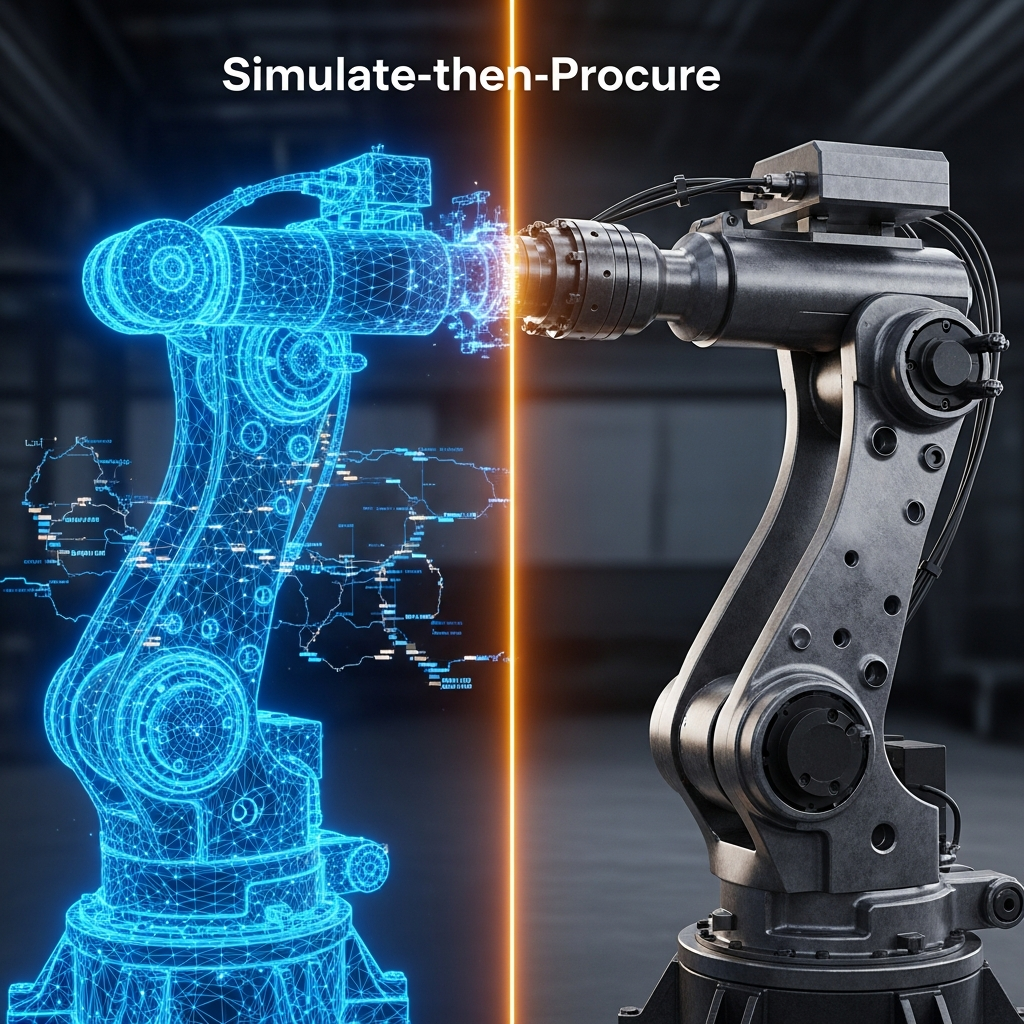
The 'Simulate-then-Procure' Pivot: Strategic Capital Allocation in Automation
Strategic Conclusion: Leading industrial organizations will shift from physical piloting to "Simulate-then-Procure" models by 2026. This transition moves automation validation from a post-CapEx engineering challenge to a pre-CapEx governance gate, potentially reducing commissioning timelines by 30-50% and converting fixed capital risks into reversible operational expenses.
The Governance Shift
Traditional industrial procurement relies on a flawed "Buy-and-Hope" model. Manufacturers historically purchase hardware to validate its viability, often discovering integration complexities only after deploying capital. This sequence exposes the balance sheet to depreciation and the organization to "pilot purgatory," where automation projects stall during scaling due to unforeseen physical constraints.
Emerging trends for 2026 signal a reversal of this workflow. Advances in physics-compliant Artificial Intelligence (Physical AI) and high-fidelity simulation now allow organizations to validate facility operations digitally before authorizing hardware expenditure. Industry analysis indicates this "Simulate-then-Procure" strategy is becoming the dominant mechanism for de-risking automation portfolios [1].
For the C-suite, this represents a capital allocation strategy rather than a technical evolution. It enables Investment Committees to demand a "Digital Proof of Value"—a simulation demonstrating that a specific configuration meets throughput targets—as a prerequisite for releasing capital.
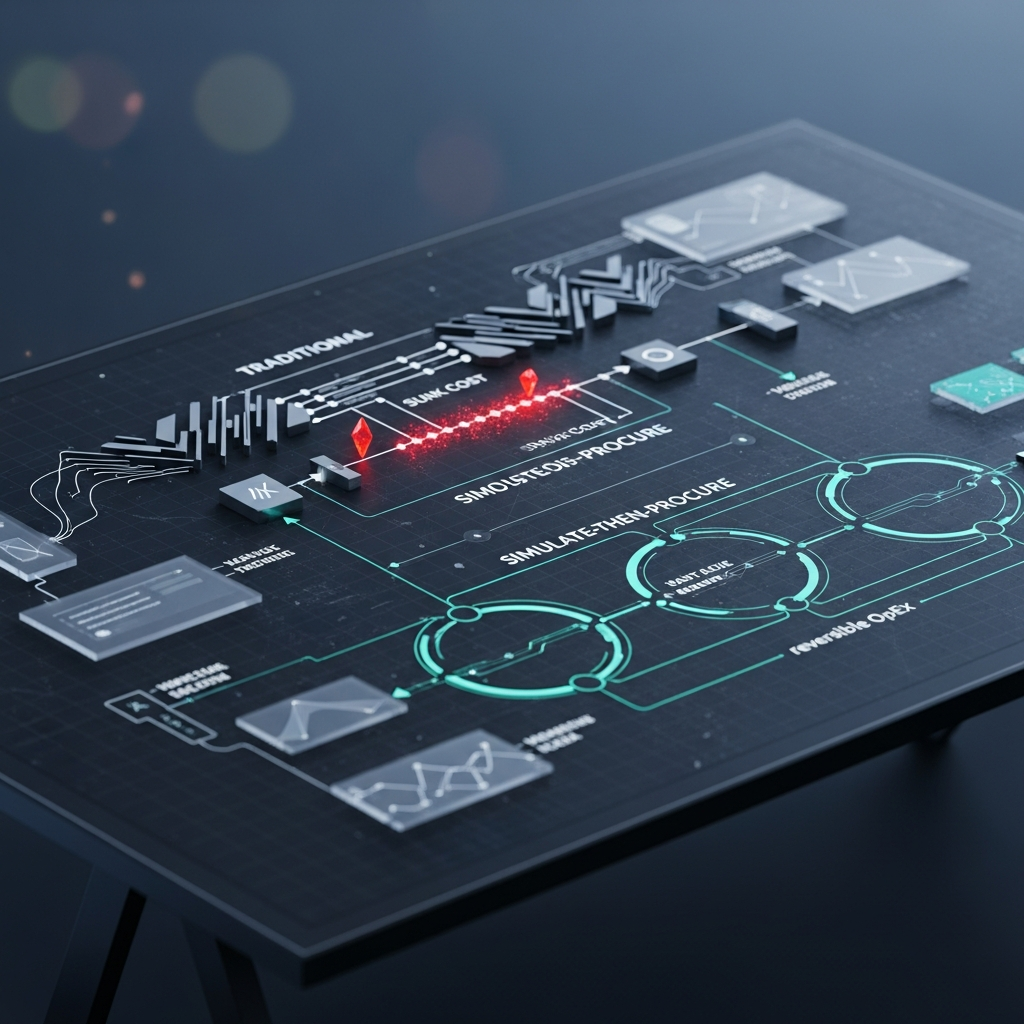
Financial Mechanics: Inverting the Capital Cycle
Simulation-led procurement converts integration risk into upfront optionality. Traditional models backload risk; if a physical pilot fails, the sunk costs in hardware and installation remain unrecoverable.
From CapEx to Reversible OpEx
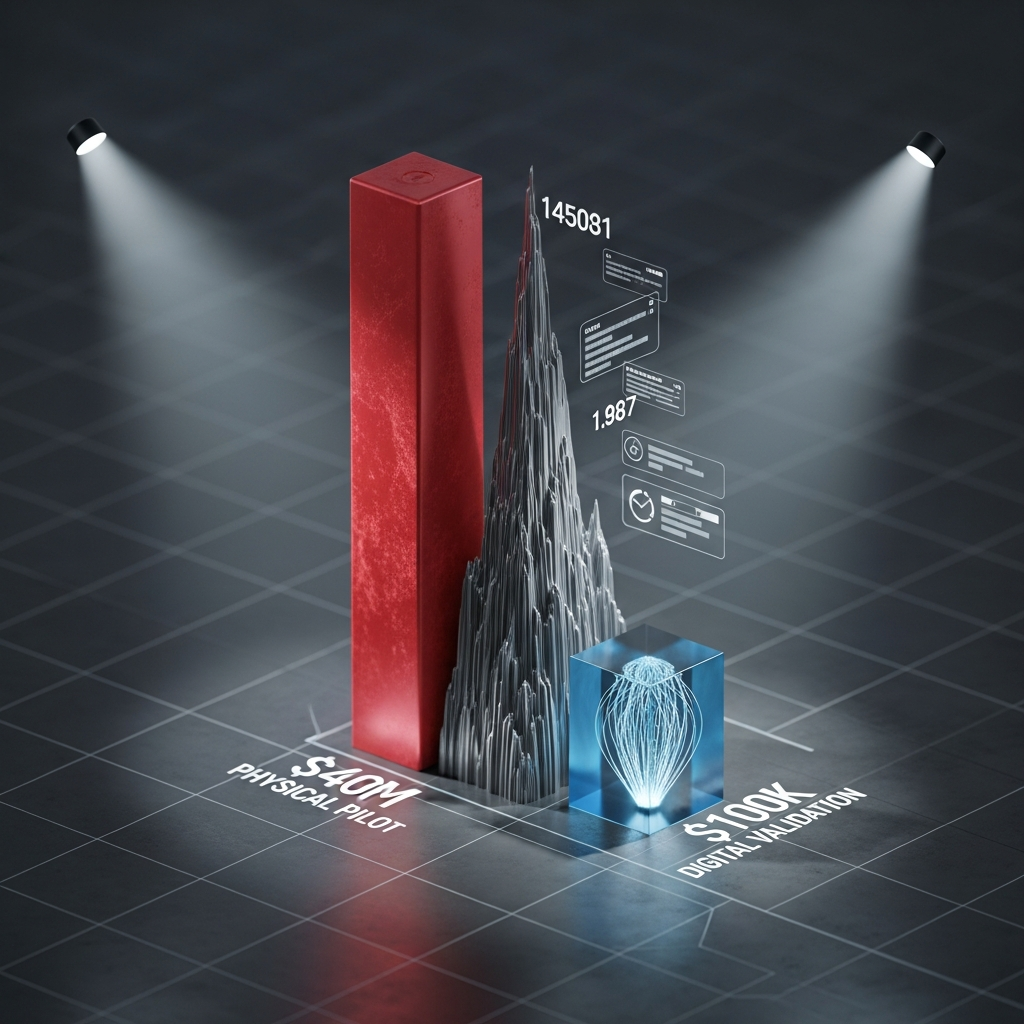
Simulation demands a restructured investment profile. While hardware CapEx is deferred, upfront OpEx for software licensing and specialized engineering increases. This expenditure buys intelligence. If a digital simulation reveals that a proposed $40 million robotics fleet will deadlock under peak load, the project can be halted or redesigned for the cost of the simulation (e.g., $50,000–$100,000) rather than the cost of the fleet.
Market data confirms the virtual commissioning sector—testing systems digitally—is expanding as firms seek to reduce the "burn rate" of idle capital during physical integration [2]. By decoupling software testing from hardware availability, organizations can parallel-process facility construction and systems integration, potentially accelerating amortization schedules by 3-6 months.
Quantifying the Efficiency Gains
Integrating GPU-accelerated frameworks, such as NVIDIA’s Isaac Lab, compresses training timelines. Robots can undergo reinforcement learning across thousands of simulated scenarios in a fraction of the time required for physical testing [3]. For a standard manufacturing facility, this translates to assets being revenue-ready weeks after installation, rather than months.
Risk Management: The 'Sim2Real' Governance Gap
Simulation offers robust validation but introduces a distinct epistemic risk: the "Sim2Real" gap. This discrepancy between a simulated environment and physical reality (e.g., lighting variations, friction coefficients, or sensor noise) can mislead executives if not properly managed.
Contractual Mitigation Strategies
Simulation must function as a contractual baseline rather than a prediction. Legal and procurement teams should structure performance-based acquisition contracts where vendor payments are tied to the physical asset matching its digital benchmark.
This approach mirrors trends in Federal Acquisition Regulation (FAR) reforms, which increasingly prioritize performance data over static specifications [4]. By establishing safety and throughput protocols in a digital environment first, the enterprise shifts the burden of proof. If the physical robot deviates from the parameters established in the Digital Twin, the variance becomes a quantifiable compliance issue.
Risk Advisory: Reliance on simulation demands rigorous oversight of the simulation parameters. If the digital environment does not accurately reflect the "messiness" of the factory floor (e.g., dust, vibration, human interference), the validation is void. Governance frameworks must include third-party auditing of the simulation assumptions.
Competitive Landscape: The Democratization of Sophistication
Accessible advanced simulation tools are upending the dynamic between industrial incumbents and mid-market challengers. Historically, only automotive and aerospace giants could afford the high-fidelity validation required to optimize complex production lines.
Market Leaders and Ecosystems
Major OEMs are now integrating hardware profiles into open ecosystems. KUKA, for example, has integrated its robotics portfolio into the 3DEXPERIENCE platform, granting broader access to high-end validation tools [5]. Similarly, NVIDIA and Siemens have partnered to create industrial metaverse blueprints that standardize fleet-level validation [6].
The Challenger Advantage
Democratization allows mid-sized competitors to iterate operations with speed. While a traditional firm physically reconfigures a conveyor belt—a process taking weeks—a digital-first competitor may test dozens of configurations virtually in days to identify the optimal solution. Gartner identifies these simulation-led strategies as a notable technology trend for 2026, suggesting that early adopters will realize efficiency gains that redefine market standards [7].
Execution Roadmap: The Talent Constraint
Workforce readiness, not software availability, constitutes the primary barrier to adopting a "Simulate-then-Procure" strategy. The skills required to build and interpret physics-compliant simulations differ significantly from traditional mechanical engineering.
Addressing the Skills Gap
Reports indicate a widening skills gap in advanced robotics and AI engineering [8]. Organizations cannot simply purchase the software; they must evaluate their human capital strategy. The complexity of these tools means that without a dedicated team or specialized integrator partners, the software risks becoming shelfware.
Strategic Options for the C-Suite
Leaders evaluating their automation strategy for the upcoming fiscal cycles face four distinct decision paths:
-
Institute Digital Gate-Checks:
- Action: For automation requests exceeding a specific threshold (e.g., $250k), the Investment Committee requires a simulation report demonstrating throughput viability.
- Impact: Prevents capital allocation to projects with unverified scaling logic.
-
Modernize Vendor Contracts:
- Action: Instruct legal teams to explore "Digital Acceptance Criteria" in Service Level Agreements (SLAs).
- Impact: Ties performance payments to the physical replication of simulated benchmarks, aligning vendor incentives with operational reality.
-
Rebalance the Engineering Budget:
- Action: Evaluate reallocating a portion of the hardware budget (e.g., 5-10%) toward simulation licensing and workforce upskilling.
- Impact: Addresses the talent bottleneck and ensures the organization possesses the capability to execute digital validation.
-
Audit "Pilot" Spending:
- Action: Review current pilot programs to identify those that are essentially "hardware-based testing."
- Impact: Identifies opportunities to pause non-committed CapEx and pivot to lower-cost digital validation.
De-risking technology exists, but it demands a governance model that values intelligence as highly as physical assets. By 2026, the differentiator between industrial leaders and laggards will not be the robots they purchase, but the rigor with which they simulate them before signing the check.
Citations
- [1] Robotics Trends 2026: Physical AI, Humanoids & The "Simulate-then-Procure" Shift
- [2] Virtual Commissioning Market Size Share & Report 2035
- [3] Isaac Lab, A GPU-Accelerated Simulation Framework for Multi-Modal Robot Learning
- [4] FAR Reform Now Underway
- [5] KUKA adds 3DEXPERIENCE to its mosaic digital ecosystem
- [6] NVIDIA Unveils ‘Mega’ Omniverse Blueprint for Building Industrial Robot Fleet Digital Twins
- [7] Gartner Identifies the Top Strategic Technology Trends for 2026
- [8] Advanced robotics engineer / Skills England
References
- The Future of Robotics in Irish Manufacturing: Trends We’re Seeing in 2025
- cloudfront.net
- Receding Horizon Control: A Comprehensive Guide for 2025
- Army and Navy Academy Cohen Lu Presents AI and Robotics Research Paper at NeurIPS 2025 SpaVLE Workshop
- researchgate.net
- NVIDIA Expands Omniverse for Factory Digital Twins; $1.2T Push
- 3ds.com
- siemens.com
- Siemens and NVIDIA to Enable Industrial Metaverse
- The Future of Manufacturing [2025-2030]
- Partner program
- preprints.org
- FAR Reform Now Underway
- Class Deviation RFO-2025-15: FAR Class Deviation for FAR Part 15 in Support of Executive Order 14275, Restoring Common Sense to Federal Procurement
- The robotics revolution: Scaling beyond the pilot phase
- studio3d
- What Collaboration Technologies Should Enterprise Leaders Watch at CES 2026?
- Robotics Trends 2026: Physical AI, Humanoids & The "Simulate-then-Procure" Shift
- gartner.com
- Top technology trends for 2026
- Top 10 Emerging Technologies in 2026
- gartner.com
- NVIDIA Unveils ‘Mega’ Omniverse Blueprint for Building Industrial Robot Fleet Digital Twins
- NVIDIA Isaac Sim: Robotics Simulation
- Implementation Analysis of Collaborative Robot Digital Twins in Physics Engines
- Virtual Commissioning Market Size Share & Report 2035
- rithassan.ac.in
- AI and the SaaS industry in 2026
- Advanced robotics engineer / Skills England
- News: ABB Robotics invests in LandingAI to transform vision AI
- designnews.com
- Virtual Commissioning Market 2025 forecast to 2032
- mckinsey.com
- fraunhofer.de