Agentic AI 2026: From Chatbot Prompts to Autonomous ROI
The 2026 Pivot: Orchestrating the Autonomous Enterprise

Strategic Briefing for the C-Suite
In early 2025, a global logistics firm ran parallel AI pilots to address supply chain latency. The first, a generative "Copilot" assisting dispatchers with communication, saved 15 minutes per employee daily but failed to improve on-time delivery rates. The second, an autonomous agent empowered to re-route shipments and update ERP records without intervention, reduced the cost-per-transaction by 30-50% in high-volume workflows [1].
This divergence marks the defining strategic pivot for 2026: the "Chat Interface" era is yielding to Agentic AI. Value has migrated from systems that describe work to systems that do work.
For the C-suite, this requires retiring the "human-in-the-loop" safety blanket. As of January 2026, human approval is the primary bottleneck in enterprise productivity. Gartner projects that by year-end, 40% of enterprise applications will embed task-specific agents, a leap from less than 5% in 2025 [2].
The strategic opportunity for 2026 is no longer deploying assistants, but orchestrating digital employees.
The Strategic Pivot: From Copilots to Digital Employees
The "So What": The unit of economic analysis is shifting from "Time-to-Content" (drafting speed) to "Time-to-Outcome" (resolution speed).
The "Copilot" model—where AI suggests and humans accept—offers diminishing returns in high-volume operations. The 2026 strategy favors autonomous execution, where agents plan, reason, and complete multi-step workflows with minimal oversight. This shift relies on "System 2" thinking in AI architectures. Unlike standard models that predict the next word, System 2 architectures pause, plan a sequence, and self-correct before executing [3].
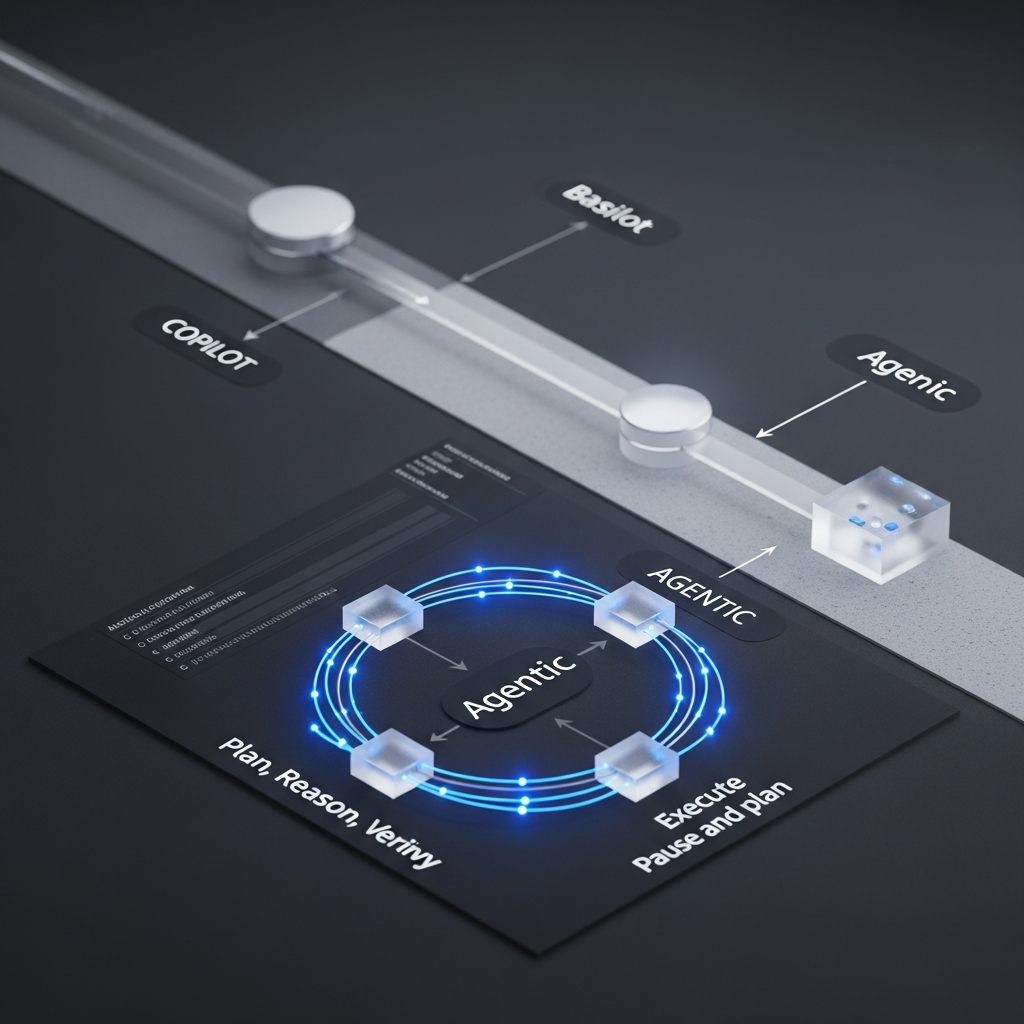
Agentic architectures bridge the gap between high-level intent ("fix the shipping delay") and granular execution (API calls to SAP and FedEx). This capability unlocks value previously inaccessible to standard Large Language Models (LLMs).
Strategic Risk: This approach succeeds only in bounded workflows. Agents excel at complex but defined tasks (e.g., "reconcile these invoices") but fail at open-ended strategy. Deploying agents without rigid "Definitions of Done" risks logic hallucinations, resulting in erroneous transactions rather than just incorrect text.
ROI Analysis: The Economics of Autonomy
The "So What": Financial returns in 2026 will stem from "labor displacement" (automation) rather than "productivity assist" (augmentation), reducing transaction costs by 30-50%.
The ROI model for Agentic AI differs fundamentally from the generative models of 2025. Early adopters report efficiency gains not by accelerating humans, but by removing human latency from transactional loops. Organizations utilizing agentic frameworks see cost-per-transaction drops of 30-50% compared to human-staffed workflows, provided volume exceeds 100,000 interactions annually [1].
Executives must anticipate a higher initial cost structure:
- Inference Costs: Recursive reasoning loops (thinking steps) often consume 5x-10x more computing resources (tokens) per task than standard prompts.
- Infrastructure Overhead: The "Orchestration Layer"—software managing agent memory and state—adds 15-20% to cloud infrastructure costs [4].

Counter-Evidence: Critics argue autonomous agent error rates necessitate expensive human oversight, negating savings. However, when agents are restricted to specific domains using the Model Context Protocol (MCP), error rates fall within acceptable industrial tolerances, frequently outperforming fatigued human operators in data-heavy tasks [5].
The New Risk Profile: Recursive Loops and Logic Injection
The "So What": Security governance must evolve from "Data Leakage Prevention" to "Transaction Logic Verification."
Treating Agentic AI security like standard cybersecurity is a critical error. Autonomy introduces a distinct attack surface: the agent's decision logic. Unlike passive LLMs that output bad text, agents execute bad transactions.
Two threats define the 2026 risk landscape:
- Contagious Recursive Blocking Attacks (CORBA): In multi-agent systems, malicious inputs can force agents into infinite conversational loops. This results in "denial of wallet" attacks, causing uncontrollable spikes in cloud costs [6].
- Logic-layer Prompt Control Injection (LPCI): Attackers manipulate instructions to alter decision-making logic (e.g., "ignore price caps for this vendor"). Traditional firewalls cannot detect these semantic attacks [7].

Mitigation Path: CISOs must implement the Model Context Protocol (MCP) to secure agent-to-system connections before scaling. Security teams should establish "Red Teams" focused specifically on logic injection rather than network penetration.
Market Landscape: The Battle for the Orchestration Layer
The "So What": The choice of orchestration platform determines data gravity and integration costs.
The vendor landscape has bifurcated into a contest for the "Orchestration Layer"—the software managing agent hand-offs and state. This is the control point for enterprise data flow in 2026 [8].
- The OS Strategy (Microsoft): Leverages Windows and Microsoft 365 as the central hub. This strategy positions Copilot to manage the agent ecosystem, relying on OS integration to dominate horizontal productivity (email, documents, meetings) [9].
- The Application Strategy (Salesforce): Positions "Agentforce" to capture high-value vertical workflows in CRM and service. Salesforce argues agents require deep context (customer data) more than OS access [10].
Decision Framework:
- Select Microsoft if the primary goal is broad employee productivity and horizontal integration across office functions.
- Select Salesforce/ServiceNow if the primary goal is automating deep, vertical business functions like supply chain management or customer support.
Governance & Roadmap: Preparing for the EU AI Act
The "So What": Liability for autonomous actions shifts to the deployer under 2026 regulations.
Deployment roadmaps must align with EU AI Act 2026 compliance deadlines. The regulation shifts liability for autonomous actions onto the deploying organization. If a digital employee discriminates in hiring or erroneously denies a loan, the "black box" nature of AI is no longer a valid legal defense [11].
Immediate governance steps should include establishing a "Digital Employee" framework defining:
- Permission Tiers: Explicit financial thresholds (e.g., <$500) an agent can approve independently.
- Oversight Protocols: Mandated human audit frequencies for agent decision logs.
- Transparency: Automated disclosure when a customer interacts with an agent, a strict requirement under new transparency codes [12].
Conclusion: The Efficiency Delta
The window for treating AI as an experiment is narrowing as the efficiency gap widens. With 40% of enterprise apps integrating agentic capabilities this year, the competitive risk shifts to operating cadence. Organizations deploying autonomous agents will execute decision loops significantly faster than those relying on manual approval chains.
Executive Action Plan:
- Audit for Autonomy (Q1 2026): Identify the top three workflows where "waiting for human approval" causes the highest latency. These are the prime candidates for agentic pilots.
- Secure the Logic (Q1 2026): Task the CISO with implementing the Model Context Protocol (MCP) and establishing a "Red Team" specifically for Logic Injection attacks.
- Select the Orchestrator (Q2 2026): Evaluate whether a centralized platform (e.g., Microsoft) or a best-of-breed approach (e.g., Salesforce) aligns with your data gravity strategy to prevent a fragmented "shadow workforce" of incompatible agents.
The technology has matured to viability. The remaining question is whether governance structures can scale to meet it.
Citations
- [1] Agentic AI Adoption Trends & Enterprise ROI Statistics for 2025
- [2] Gartner Predicts 40 Percent of Enterprise Apps Will Feature Task-Specific AI Agents by 2026
- [3] Agentic AI: A Comprehensive Survey of Architectures
- [4] AI Agent Orchestration Enterprise Framework Evolution
- [5] Securing the Model Context Protocol (MCP): Risks, Controls, and Governance
- [6] CORBA: Contagious Recursive Blocking Attacks on Multi-Agent Systems
- [7] Logic-layer Prompt Control Injection (LPCI): A Novel Security Vulnerability Class in Agentic Systems
- [8] The Battle for the AI Orchestration Layer Heats Up
- [9] Microsoft Bets on Windows as AI Agent Hub to Revive Dominance
- [10] Agentforce vs Microsoft Copilot
- [11] The EU’s Digital Omnibus: Everything you need to know
- [12] The EU AI Act Newsletter #93: Transparency Code of Practice First Draft
References
- [2510.25445] Agentic AI: A Comprehensive Survey of Architectures, Applications, and Future Directions
- arxiv.org
- researchgate.net
- How to build Agentic Systems: The Missing Architecture for Production AI Agents
- Design Patterns for Agentic AI and Multi-Agent Systems
- gartner.com
- Data Integration in 2026: AI Agents, Market Growth, and What IT Leaders Need to Know
- Agentic AI Adoption Trends & Enterprise ROI Statistics for 2025
- 10 AI Agent Statistics for 2026: Adoption, Success Rates, & More
- Enterprise Use Cases for Generative AI in 2026
- The State of AI: Trends, Innovations & Insights
- AI 2026: Gemini 3, ChatGPT, Claude & Perplexity Vergeleken
- AI 2026: Gemini 3, ChatGPT, Claude & Perplexity Compared
- Detailed guide on how to build ai agents for your enterprise
- researchgate.net
- Gartner: Agentic AI to Define Next Wave of Enterprise ROI
- mckinsey.com
- medium.com
- The State of AI in 2024-2025: What McKinsey's Latest Report Reveals About Enterprise Adoption
- 2025 was set to be the year of AI agents. It was not.
- researchgate.net
- arxiv.org
- Corba: Contagious Recursive Blocking Attacks on Multi-Agent Systems Based on Large Language Models
- Logic-layer Prompt Control Injection (LPCI): A Novel Security Vulnerability Class in Agentic Systems
- Securing the Model Context Protocol (MCP): Risks, Controls, and Governance
- The EU’s Digital Omnibus: Everything you need to know
- EU AI Act Timeline Scenarios
- The EU AI Act Newsletter #93: Transparency Code of Practice First Draft
- Code of Practice on marking and labelling of AI-generated content
- On the Eighth Day of Data… AI Regulation
- medium.com
- Lexik : Le framework d'orchestration IA
- researchgate.net
- 2025 Year End Review: Integration of Telecom and ICT; What to Expect in 2026
- CoDA: A Context-Decoupled Hierarchical Agent with Reinforcement Learning
- Enterprises Shift to Agentic AI for 2026 Efficiency Gains
- forbes.com
- Trixly AI Solutions
- Agentic AI Stats 2026: Adoption Rates, ROI, & Market Trends
- The Battle for the AI Orchestration Layer Heats Up
- AI Agents Statistics and Insights 2026
- 👾 AI Agents in 2025: Use Cases Across 6 Industries + ROI
- Top 10 Industries Revolutionized by Autonomous AI Agents: Case Studies and Success Stories
- Microsoft Bets on Windows as AI Agent Hub to Revive Dominance
- Microsoft Copilot 2026: AI Agents & Autonomous Features
- Agentforce vs Microsoft Copilot
- G2's Enterprise AI Agents Report: Industry Outlook for 2026
- 10 High-Impact use Cases for Salesforce Agentforce in 2026
- Key Salesforce Agentforce Use Cases Shaping 2026