Agentic AI Orchestration: Building the 2026 Control Layer

The Agentic Mesh: Why the 2026 Control Layer is a Protocol, Not a Platform
Forrester called it in 2025: Agentic AI will trigger major breaches in 2026 [1]. With Gartner confirming 40% of enterprise apps now run task-specific agents [2], we are watching that prediction manifest in real-time. The failure mode isn't model stupidity; it's naive control planes. We are routing 10M daily non-deterministic decisions through "hub-and-spoke" platforms built for deterministic workflows. That creates a blast radius no amount of prompt engineering can contain.
The Death of the Monolithic Orchestrator
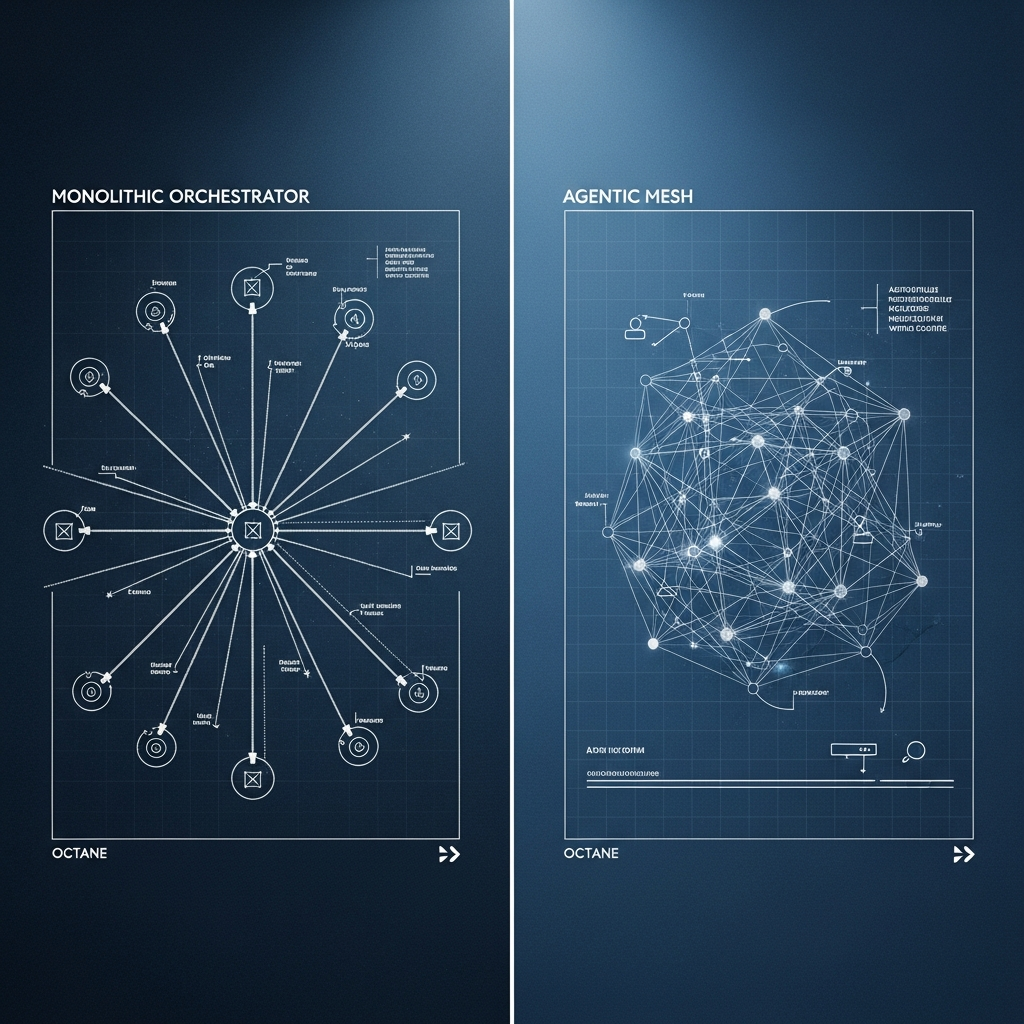
At 10M requests/day, the centralized "God-mode" supervisor pattern—where a single LLM dictates every sub-agent's next step—becomes a latency anchor and a single point of failure. Recent architecture shifts favor a decentralized "Agentic Mesh," distributing decision rights to the edge [3]. In this mesh, agents act as microservices negotiating directly, removing the central bottleneck.
The Trade-off: You gain throughput and resilience at the cost of consistency. In a centralized model, you know exactly why a workflow failed. In a mesh, failure is emergent. While decentralized architectures scale, they suffer from "consensus drift," where agents optimize for local goals and degrade the global outcome [4].
Standardization: MCP is the New HTTP

The "Control Layer" is not a product you buy; it is a protocol you implement. The industry has settled on the Model Context Protocol (MCP) for interoperability, effectively treating it as the HTTP of the agentic web [5]. If your agents communicate via custom JSON schemas or proprietary vendor SDKs, you are building technical debt.
MCP solves the N×N integration problem by standardizing how agents expose context (resources, prompts, tools). Below is a configuration for an MCP server exposing a database as a tool-use resource:
{
  "mcpVersion": "2025-11-01",
  "server": {
    "name": "postgres-read-replica-agent",
    "capabilities": {
      "resources": { "subscribe": true },
      "tools": { "listChanged": true }
    }
  },
  "resourceTemplates": [
    {
      "uriTemplate": "postgres://db-prod/orders/{id}",
      "mimeType": "application/json",
      "description": "Read-only access to order context"
    }
  ]
}
Adhering to this protocol decouples intelligence (the model) from connectivity (the mesh). You can swap the underlying LLM of a specific agent without breaking the integration contract with the rest of the fleet.
Governance as Code: The ISO 42001 Circuit Breaker
You cannot prompt-engineer safety into a system handling 10M autonomous decisions. Governance must be immutable infrastructure. With ISO/IEC 42001 becoming the standard for AI management [6], the Control Layer must function as a compliance engine that cryptographically enforces decision rights.
We are seeing "Circuit Breaker" patterns where the orchestration layer intercepts agent actions before execution. This is not a "guardrail" (guidance); it is a hard stop.
class ISO42001CircuitBreaker:
    def intercept(self, agent_action: Action, context: Context):
        # HARD RULE: No financial transaction > $500 without human-in-the-loop
        if agent_action.tool == "stripe_payout" and agent_action.amount > 500:
            if not context.has_human_approval_signature():
                raise PolicyViolationError(
                    code="ISO_42001_CONTROL_A_7_2",
                    message="Automated financial threshold exceeded."
                )

        # HARD RULE: PII Data Egress Check
        if self.pii_scanner.detects_sensitive_data(agent_action.payload):
             return self.sanitize(agent_action.payload)

        return agent_action.execute()
This shifts liability from the probabilistic model to deterministic code. Legal teams demand this auditability, a necessity highlighted in recent 2026 legal trend analysis [7].
The Latency and Observability Tax
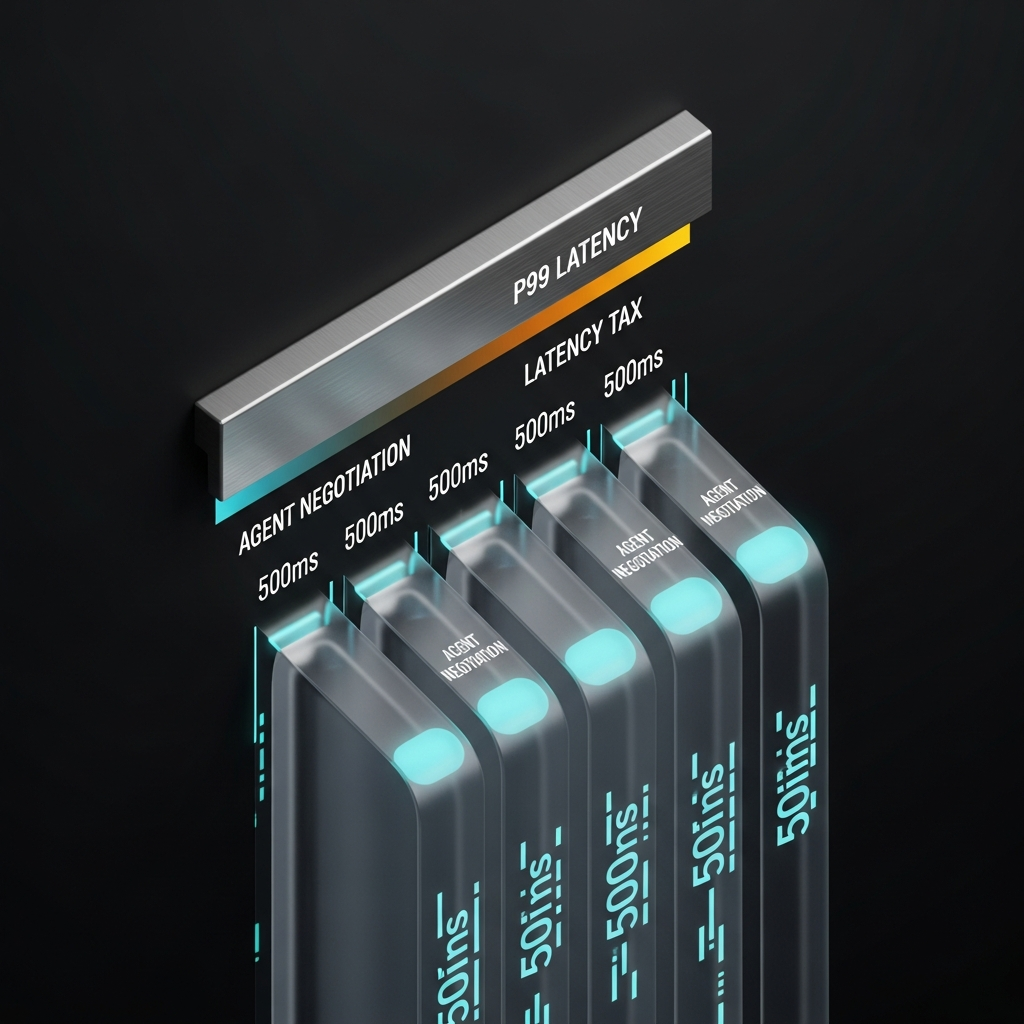
Decentralization is not free. Benchmarks from late 2025 show multi-agent frameworks bleed performance compared to monolithic calls [8]. In a mesh, a user request might trigger a chain of 5-10 agent-to-agent negotiations. If each negotiation incurs 500ms inference latency plus network overhead, P99 latency exceeds 5 seconds immediately.
Debugging a non-deterministic mesh is impossible without distributed tracing. If you deploy without a robust OpenTelemetry (OTEL) implementation, you are flying blind. You must tag every span with gen_ai.system and gen_ai.request.model to correlate costs and errors [9]. Without this, you cannot distinguish between a network timeout and a model refusing to answer due to safety filtering.
Migration Path: Wrap, Don't Replace
Do not rewrite core business logic as agents. Follow the "Command Layer" methodology: wrap existing, deterministic APIs in MCP servers first [10].
- Phase 1 (Infrastructure): Deploy an MCP-compatible gateway.
- Phase 2 (Wrap): Expose "dumb" APIs (SQL, REST) as MCP resources.
- Phase 3 (Agentify): Deploy task-specific agents that consume these resources.
This ensures that when agents inevitably fail or hallucinate, the underlying data layer remains uncorrupted and accessible via standard protocols. Intelligence is a transient service; the protocol (MCP) and safety guarantees (ISO 42001) are permanent infrastructure.
Citations
- [1] Forrester Says Agentic AI Will Trigger Major Breaches in 2026
- [2] Gartner predicts task-specific AI agent growth
- [3] Agentic Mesh: The Future of Scalable AI Collaboration
- [4] Advancing Multi-Agent Systems Through Model Context Protocol: Architecture, Implementation, and Applications
- [5] Model Context Protocol (MCP) Guide: Enterprise Adoption 2025
- [6] ISO/IEC 42001: Features, Types & Best Practices
- [7] Ten AI Predictions For 2026: What Leading Analysts Say Legal Teams Should Expect
- [8] Why Your Multi-Agent Framework is Bleeding Performance
- [9] Semantic Conventions for Generative AI Agentic Systems (gen_ai.*)
- [10] Multi-Agent Warehouse AI Command Layer Enables Operational Excellence and Supply Chain Intelligence
References
- medium.com
- [2504.21030] Advancing Multi-Agent Systems Through Model Context Protocol: Architecture, Implementation, and Applications
- medium.com
- idc.com
- How Agentic AI Works: Technical Architecture Behind the Autonomous Enterprise
- Multi-Agent Warehouse AI Command Layer Enables Operational Excellence and Supply Chain Intelligence
- Agentic AI adoption to accelerate in 2026
- gartner.com
- 7 Agentic AI Trends to Watch in 2026
- gartner.com
- Gartner predicts task-specific AI agent growth
- 5 Bold Predictions on the Rise of Agentic AI and the $30B Orchestration Boom
- 4 CIO trends to watch in 2026
- Ten AI Predictions For 2026: What Leading Analysts Say Legal Teams Should Expect
- From experimenting 🧪 to scaling 🚀 and industrializing 🏭: Enterprise AI 2026 as a turning point towards structured business operations 🤖
- medium.com
- ISO/IEC 42001: Features, Types & Best Practices
- ISO/IEC 42001 Explained: Managing AI Safely and Effectively
- codiste.com
- 14 AI Agent Frameworks Compared: LangChain, LangGraph, CrewAI, OpenAI SDK, and More
- medium.com
- AI Agent Orchestration Explained: How Intelligent Agents Work Together
- arxiv.org
- Agentic Mesh: The Future of Scalable AI Collaboration ['26]
- medium.com
- Model Context Protocol (MCP) Guide: Enterprise Adoption 2025
- Model Context Protocol
- ieee.org
- IEEE Computer Society/Artificial Intelligence Standards Committee (C/AISC)
- 2026 will be the Year of Multiple AI Agents
- medium.com
- Which Enterprise Use Cases Are Best for Agentic AI in 2025?
- Predictions 2026: AI Agents And New Business Models Impact Enterprise Software
- GovTech Intelligence Hub
- Forrester Says Agentic AI Will Trigger Major Breaches in 2026
- Multi-Agent Systems: Architecture, Patterns, and Production Design
- Temporal + AI Agents: The Missing Piece for Production-Ready Agentic Systems
- Semantic Conventions for Generative AI Agentic Systems (gen_ai.*) · Issue #2664 · open-telemetry/semantic-conventions · GitHub
- Trustworthy AI Agents: Kill Switches and Circuit Breakers
- medium.com
- IEEE SA
- AgentRace: Benchmarking Efficiency in LLM Agent Frameworks
- Why Your Multi-Agent Framework is Bleeding Performance
- medium.com