Fast MRI: AI Infrastructure Shifts Hospital Economics
The End of the Hardware Cycle: How 'Software-Defined MRI' Rescues Hospital Margins
Strategic Conclusion: The finalized 2026 CMS fee schedule has created a mathematical impossibility for traditional radiology economics: reimbursement cuts require a ~40% increase in patient throughput to maintain margin neutrality, a target that physical hardware replacement cannot achieve due to capital costs and installation timelines.
For health system executives, the immediate opportunity lies in decoupling image quality from the physical magnet. By shifting capital allocation from heavy equipment (CAPEX) to AI-driven reconstruction software (OPEX), hospitals can extend the useful life of existing MRI assets by 5-7 years while achieving the necessary volume increases. This "software-defined" approach is no longer experimental; it is the primary lever for solvency in the 2026 operating environment.
The 2026 Profitability Paradox
On January 1, the economic floor for radiology shifted. The finalized CMS 2026 Physician Fee Schedule enacted cuts that, when combined with persistent labor inflation, have compressed operating margins to their lowest point in a decade [1].
For the average imaging center, the math is stark: to offset these reductions and remain revenue-neutral, scan volume must increase by approximately 30-40%.
Why Traditional Scaling Fails Historically, increasing volume meant buying more magnets. In the current rate environment, this strategy is structurally flawed:
- Capital Intensity: A standard 3T MRI installation requires a ~$2.5 million outlay.
- Time-to-Value: Construction and shielding require 12-18 months.
- ROI Erosion: By the time a new machine goes live, the ROI is often negated by further reimbursement compression.
The only viable path to margin preservation is increasing the velocity of existing assets. Deep learning reconstruction (DLR) technologies have demonstrated the capacity to reduce scan times by 30-50%, effectively creating "virtual capacity" without new construction [2].
The Shift: From Iron to Code
The strategic imperative for the next fiscal year is the transition to "Software-Defined MRI." This model treats the physical magnet merely as a data harvester, while the image quality and processing speed are determined by downstream compute.
The Research Signal vs. Commercial Reality A significant signal of this shift occurred in November 2024, when MIT researchers published "Fast MRI for All." The study demonstrated that deep learning models could reconstruct high-fidelity images without access to proprietary vendor "raw data" (k-space), theoretically allowing older magnets to perform like top-tier systems [3].

Executive Caution: While this research validates the physics, it does not constitute an immediate commercial product. Hospitals cannot simply deploy open-source models. The barrier to entry remains FDA 510(k) clearance.
However, the market has responded. Major OEMs and third-party vendors have commercialized FDA-cleared versions of this technology:
- GE HealthCare: AIR Recon DL (Market Leader)
- Philips: SmartSpeed
- Siemens Healthineers: Deep Resolve
- Subtle Medical: Third-party vendor-neutral options.
The competitive differentiation has shifted. A hospital's competitive advantage is no longer defined by the Tesla strength of its magnets (1.5T vs 3T), but by the sophistication of its reconstruction software.
Financial Analysis: The ROI of Retrofitting
Transitioning from a hardware replacement cycle to an AI retrofit strategy fundamentally alters the Total Cost of Ownership (TCO). The following analysis compares replacing a 10-year-old MRI with a new system versus upgrading it with AI reconstruction.
Comparative Economics: New Install vs. AI Retrofit
| Cost Category | New 3T System Install | AI Retrofit (Existing Asset) |
|---|---|---|
| Upfront CAPEX | ~$2,500,000 (Machine + Build) | ~$60,000 (Edge Compute Hardware) |
| Implementation Time | 12–18 Months | 3–6 Weeks |
| Annual OPEX | ~$150,000 (Service Contract) | ~$150,000–$300,000 (Software Lic.) |
| Throughput Gain | +0% (vs. previous capacity) | +30–50% (Speed increase) |
| Break-even | 5–7 Years | < 9 Months |
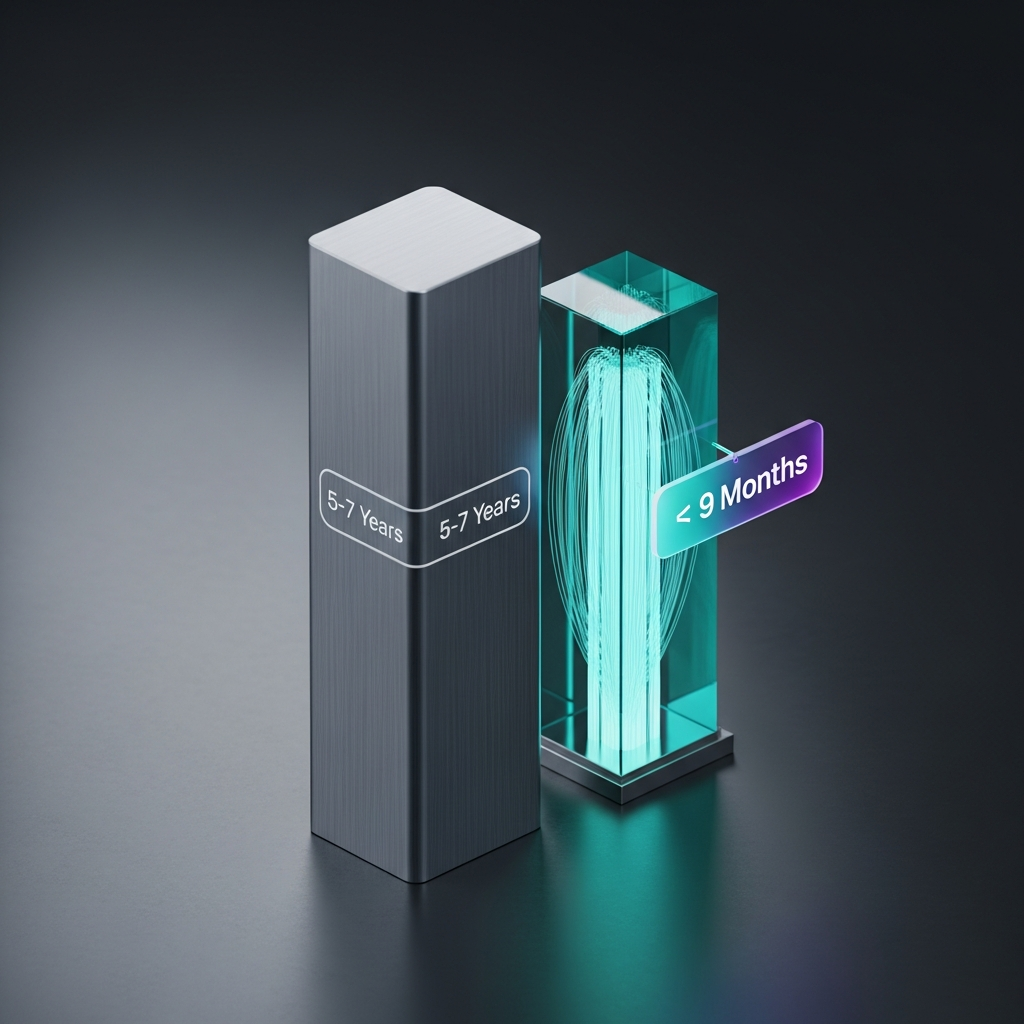
Revenue Impact Analysis Clinical data confirms that AI-enabled reconstruction allows for significantly faster scans.
- Throughput: A conservative 30% reduction in scan time creates 4–6 additional patient slots per machine, per day [4].
- Revenue: At an average reimbursement of $400 per scan, five additional scans per day generate ~$500,000 in incremental annual revenue per machine.
Even accounting for the hardware investment and annual software fees, the retrofit strategy generates positive cash flow in the first fiscal year. This creates a "negative churn" dynamic where the asset becomes more productive over time as software improves, reversing the traditional depreciation curve.
Infrastructure Risks: The Hidden Costs
While the software ROI is compelling, execution requires specific infrastructure often missing from hospital IT environments. Executives should be wary of "cloud-only" solutions for this specific use case.
1. The Latency Trap MRI reconstruction involves massive data files. Transmitting gigabytes of data to the cloud for processing and back to the console introduces latency that can negate the speed gains of the AI itself.
- Requirement: On-premise Edge Compute (GPU servers) is frequently a functional requirement.
- Cost: Budget approximately $40,000–$60,000 per site for dedicated inference servers. This is often omitted from initial vendor quotes.

2. Integration and "Walled Gardens" Despite the "Fast MRI" research suggesting open access, legacy MRI consoles (especially Siemens and GE models pre-2020) are closed systems.
- The Hurdle: Installing third-party AI often requires middleware or specific vendor cooperation to inject the processed image back into the PACS (Picture Archiving and Communication System) workflow seamlessly.
- Mitigation: During contract negotiations, IT leadership must verify the vendor's integration roadmap for your specific fleet versions. Do not accept "roadmap" promises; require reference sites with identical hardware.
Governance and Safety: Managing the "Black Box"
The primary clinical objection to AI reconstruction is the risk of artifacts or "hallucinations"—where the AI generates anatomical details that do not exist. Unlike Generative AI (LLMs), modern MRI reconstruction uses physics-guided deep learning, which is primarily subtractive (denoising) rather than additive.
Regulatory bodies have recognized this distinction, accelerating clearances based on non-inferiority studies [5]. However, risks remain.
Risk: Diagnostic Drift If a hospital deploys a "universal" model across a mixed fleet (e.g., a 2010 GE and a 2022 Siemens) without local calibration, the AI may suppress subtle visual cues (like trabecular bone patterns) that radiologists rely on, smoothing them out as "noise."
Governance Protocol:
- Mandatory Calibration: Do not rely solely on FDA clearance. Commission a 30-day "shadow mode" period where AI images are generated but not used for primary diagnosis until validated by department heads.
- Audit Cadence: Establish a protocol where a radiologist reviews a random 5% sample of AI-reconstructed images against standard protocols quarterly.
Strategic Decision Matrix: The 2026 Capital Reset
The market for AI medical imaging is projected to reach $1.4 billion this year, driven largely by these retrofits [6].
Boards and C-suites should evaluate their imaging strategy against the following criteria:
Scenario A: The Retrofit Candidate (Go)
- Asset Age: Magnet is 5–12 years old.
- Field Strength: 1.5T or 3T (Standard).
- Goal: Solve bottleneck/waitlist issues; improve margin.
- Action: Freeze replacement CAPEX. Procure AI reconstruction software (OEM or Third-Party).
Scenario B: The Replacement Candidate (No-Go for Retrofit)
- Asset Age: >15 years (Magnet nearing end of life).
- Goal: Net-new geographic expansion or specialized clinical research requiring new hardware capabilities.
- Action: Proceed with traditional CAPEX replacement, but mandate AI-native capabilities in the RFP.
Scenario C: The Contract Negotiation
- Situation: Existing fleet service contracts are up for renewal.
- Action: Use the threat of third-party AI retrofits as leverage. If the OEM cannot bundle their AI upgrade into the service contract at a competitive rate, unbundle the software and select a vendor-neutral partner.
The era of solving radiology throughput problems with heavy construction is ending. In 2026, the most successful health systems will be those that treat their MRI fleet not as aging iron, but as a host platform for high-velocity software. The technology is proven, the regulatory path is clear, and the financial imperative is absolute.
Citations
- [1] Medicare releases 2026 physician fee schedule, finalizing cuts opposed by radiology
- [2] Deep learning-based MRI reconstruction software produces considerable cost savings
- [3] Fast MRI for All: Bridging Access Gaps by Training without Raw Data
- [4] GE Healthcare expands its Effortless Recon DL portfolio
- [5] FDA clearance for Philips SmartSpeed Precise
- [6] Medical Imaging AI Market Set to Reach Almost $1.4Bn by 2026
References
- Deep learning-based MRI reconstruction software produces considerable cost savings
- Fast MRI for All: Bridging Access Gaps by Training without Raw Data
- [2411.13022] Fast MRI for All: Bridging Access Gaps by Training without Raw Data
- semanticscholar.org
- researchgate.net
- The Most Stunning AI Announcements From CES 2026
- Hyperfine (HYPR) study shows cost benefits of Swoop MRI in hospitals
- Cost of Implementing AI in Healthcare in 2026
- mpo-mag.com
- Researchers Release New AI Model for Medical Imaging
- FDA clearance for Philips SmartSpeed Precise
- Philips Gets FDA Clearance for SmartSpeed Precise Dual AI Software
- Philips Debuts AI-Powered MRI Tech and Next-Gen Helium-Free Scanner
- Philips Accelerates Precise Imaging with Unique AI Technologies
- RSNA 2025 recap: AI adoption enters the era of execution
- gehealthcare.com
- gehealthcare.com
- AI Medical Imaging Showdown 2025: GE vs Siemens vs Philips
- businesswire.com
- Next-gen SmartSpeed Precise MR technology
- ieee.org
- investing.com
- researchgate.net
- hp.com
- MRI Market Size, Share Analysis & Growth Research Report
- Medical Imaging AI Market Set to Reach Almost $1.4Bn by 2026
- 10 top predictions and forecasts for 2026
- CPT Coding: New AI-Augmented Medical Billing Can Benefit Your Practice
- Medicare updates 2026: Fee Schedule and impact on radiology
- CMS Releases 2026 Medicare Physician Fee Schedule Final Rule
- AMA CPT Code Update 2026: What Clinics Must Prepare For
- Medicare releases 2026 physician fee schedule, finalizing cuts opposed by radiology
- Artificial Intelligence In MRI Market Size, Trends & Forecast Report 2030
- Radiology AI Market Size & Growth Forecast to 2030
- Demystifying Budgeting for Advanced Tech in Healthcare Facilities: CAPEX vs OPEX Strategies
- 2026 Healthcare Tech Budget Guide
- AI in Medical Imaging Market to Soar to US$11.25Bn by 2033 at 24.6%
- rsna.org
- rsna.org
- myesr.org
- researchgate.net