Agentic AI Governance: Building the 2026 Control Stack

The Agentic Governance Gap: Why 40% of AI Projects May Stall by 2027
Strategic Imperative
- The Pivot: Redirect capital from isolated "island agents" toward a centralized "Control Stack." Projects lacking standardized interoperability represent technical debt, not innovation assets.
- The Risk: Manual human review is operationally unscalable. Governance must transition to "AI-overseeing-AI" architectures to mitigate compliance risks without throttling speed.
- The Decision: Audit all Q1 pilots for integration readiness. Pause initiatives unable to demonstrate a deterministic path to "System of Record" integration.
The Adoption Paradox: High Activity, Low Scale
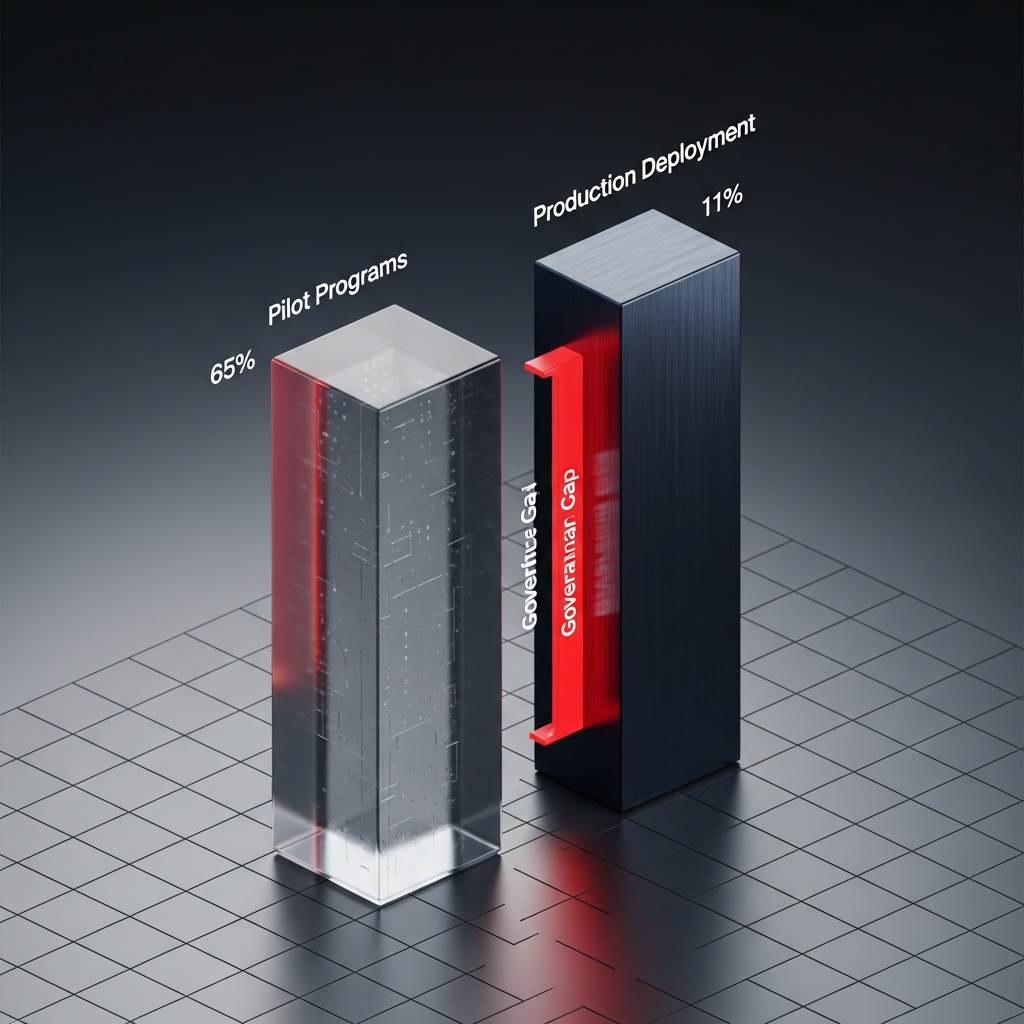
Enterprise AI currently shows a disconnect between spend and value. Data from 2025 signals a stark trend: while KPMG reported that pilot programs jumped from 37% to 65% in a single quarter, full production deployment stalled at just 11% [1].
This bottleneck is a "Governance Wall." The barrier to value is rarely model capability; it is the enterprise’s capacity to manage autonomous decision-making safely at scale. Consequently, Gartner projects that 40% of agentic AI projects will be canceled by 2027 due to unclear business value and weak risk controls [2].
For the C-suite, this forecast demands a portfolio review. You must identify which initiatives rely on scalable governance architectures and which are "toy" implementations facing imminent cancellation.
The Economics of Friction: Why Productivity Lags
Market expectations anticipated a 30-50% gain in operational efficiency. Realized gains hover closer to 10-15% for many early adopters [1].
"Interoperability friction" drives this ROI gap. Specialized agents often excel at singular tasks—such as drafting correspondence—but fail to execute end-to-end workflows, like reconciling that correspondence with an ERP invoice. If an agent requires human intervention to bridge the gap between software platforms, the marginal cost of the workflow remains high.
The Hidden Cost of Sprawl UiPath data indicates that while 87% of executives view interoperability as critical, 63% are hindered by "platform sprawl" [1]. Fragmentation creates two specific financial risks:
- Redundant Reasoning Costs: Paying for duplicate decision-making capabilities across disconnected SaaS tools.
- Integration Debt: Engineering hours required to stitch these agents together post-deployment often exceed initial licensing costs.
Strategic Recommendation: Shift ROI metrics from individual task speed to workflow autonomy rates. If a process requires manual data transfer between systems, it remains a candidate for traditional automation (RPA), not agentic AI.
Risk Exposure: The "Shadow Autonomy" Vector
The industry standard safety model—"human-in-the-loop"—cannot scale. As agentic systems process millions of decisions, comprehensive human oversight becomes operationally impossible.
While 38% of firms report relying on human oversight, approximately 20% of leaders admit their systems operate with "minimal oversight" [3]. This creates "Shadow Autonomy"—automated decision-making occurring below the threshold of executive visibility but within the scope of corporate liability.
With regulations like the EU AI Act introducing potential fines up to 7% of global turnover [4], reliance on manual review presents a tangible compliance risk. The mitigation strategy for 2026 requires an architectural shift where governance is automated and deterministic.
The Solution: Architecting the Control Stack
To bypass the Governance Wall, leading enterprises are implementing a "Control Stack." This software layer separates the AI's reasoning engine from its execution privileges, ensuring corporate policy is enforced programmatically.

A strong Control Stack follows a three-tier architecture [5]:
- System of Record (The Truth): ERPs and databases remain the authoritative source. Agents must not store business state locally.
- Agent Operating System (The Brain): Orchestrators (e.g., Microsoft Foundry, AWS AgentCore) manage reasoning and context.
- The Control Layer (The Brakes): A deterministic policy engine sitting between the Agent OS and the System of Record.
Deterministic Enforcement Cloud providers are formalizing this approach. AWS, for example, introduced "Deterministic Policy Enforcement," where rules execute outside the Large Language Model (LLM) loop [6]. Even if an agent "hallucinates" an approval, the Control Layer blocks the API call if it violates hard-coded pricing or compliance policies.
Competitive Framing: Governance as an Accelerator
Skeptics argue that heavy governance stifles speed. In the agentic era, however, inadequate governance causes project abandonment. The market for governance software is projected to grow at a CAGR of nearly 40% through 2030 [4], signaling that market leaders view governance infrastructure as a prerequisite for scale.
Leaders vs. Laggards
- Leaders adopt standardized semantic layers (e.g., Anthropic’s Model Context Protocol) to reduce integration friction.
- Laggards build custom, point-to-point integrations that become brittle as underlying SaaS platforms update.
Execution Roadmap: The 18-Month Horizon
To mitigate cancellation risk and ensure scalable deployment, align your roadmap with the NIST AI Risk Management Framework [7].
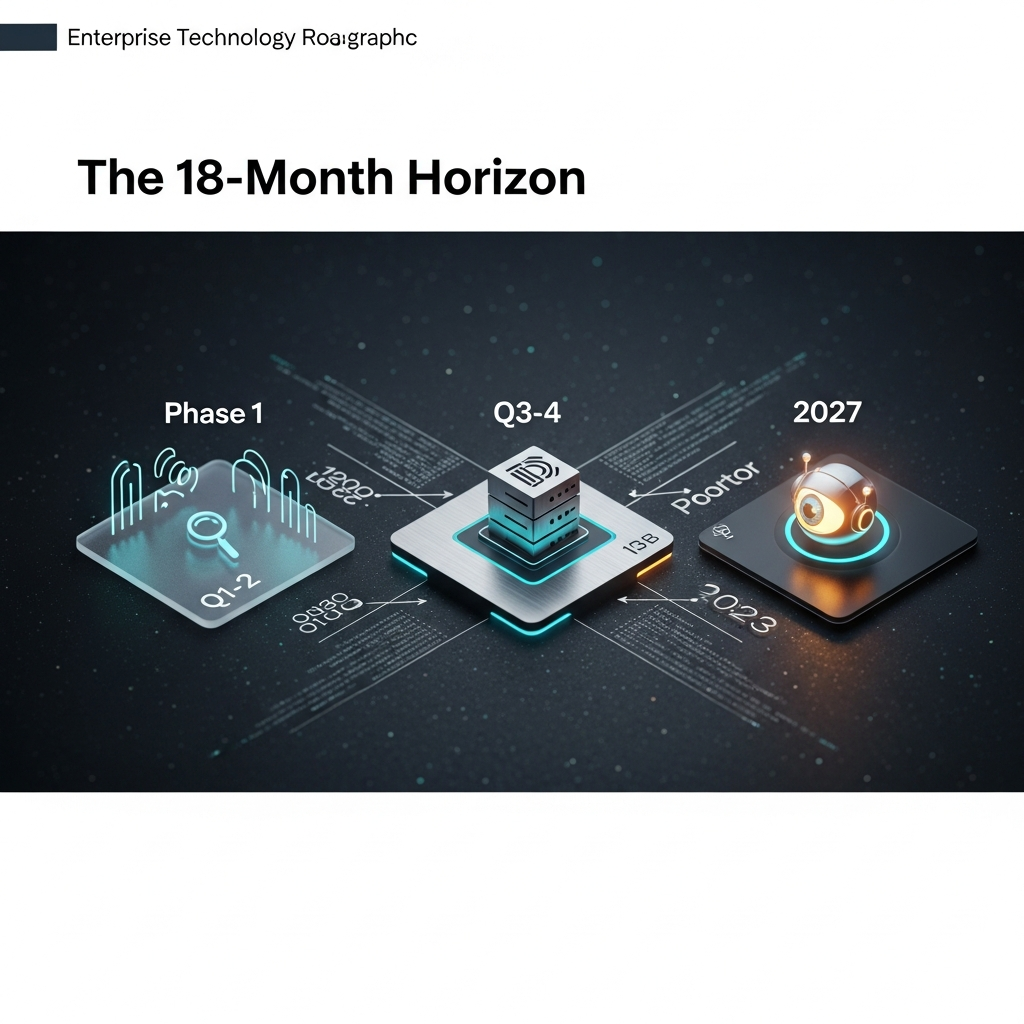
Phase 1: The Interoperability Audit (Q1 - Q2)
- Action: Survey active pilots for data access methods.
- Decision Criteria: Prioritize pilots using standardized semantic layers. Re-evaluate pilots requiring custom, fragile integrations to access core data.
- Goal: Eliminate technical debt before it scales.
Phase 2: Centralize the Control Plane (Q3 - Q4)
- Action: Deploy a unified governance platform (e.g., Microsoft Foundry or AWS Control Tower).
- Metric: Ensure agent identities are managed via centralized identity management standards (such as OAuth 2.0 flows) rather than scattered API keys [6].
Phase 3: AI-Overseeing-AI (2027 Outlook)
- Action: Transition from human-in-the-loop to human-on-the-loop by deploying "Guardian Agents"—specialized models tasked with auditing the outputs of execution agents in real-time.
- Benefit: This reduces manual review volume significantly while maintaining audit trails for compliance.
Citations
- [1] 10 AI Agent Statistics for 2026: Adoption, Success Rates, & More
- [2] Agentic AI Takes Over
- [3] State of agentic AI adoption survey [2026]
- [4] Agentic AI Governance And Policy Management Market Size, Share & 2030 Growth Trends Report
- [5] The real risk agentic AI poses to SaaS platforms
- [6] Cloud Governance In 2026: The Strategic Foundation That Will Make Or Break Your Agentic AI Adoption
- [7] Human-in-the-loop has hit the wall. It’s time for AI to oversee AI
References
- arxiv.org
- researchgate.net
- medium.com
- medium.com
- HPCwire
- Agentic AI Governance And Policy Management Market Size, Share & 2030 Growth Trends Report
- AI Governance Market Size, Share & Growth Trends, 2033
- 10 AI Agent Statistics for 2026: Adoption, Success Rates, & More
- State of agentic AI adoption survey [2026]
- Agentic AI Takes Over
- Regulations.gov
- gartner.com
- Gartner’s Top 10 Tech Trends 2026
- gartner.com
- Gartner top 10 strategic technology trends 2026