Agentic AI vs. The Seat Model: The Coming SaaS Revenue Crisis

The 2026 Pricing Pivot: Why the 'Death of the Seat' is a Retention Upgrade
As of January 2026, the linear relationship between enterprise headcount and software spend has broken. The rise of autonomous agents—software that executes workflows rather than just assisting humans—renders the "per-seat" license a liability. While CFOs often fear the volatility of consumption-based pricing, data from early movers proves this shift is accretive to retention and value alignment. The primary risk is no longer "cannibalizing" revenue; it is paying human-scale prices for machine-scale work.
Bottom Line:
- STOP: Signing 3-year renewals based on current headcount projections. 40% of G2000 roles will involve agentic workflows this year, likely reducing seat utilization.
- START: Auditing "phantom seats"—licenses held by employees where >50% of the workflow has been delegated to agents.
- DECISION: Mandate "Flex Agreements" for all Q1 software renewals, ensuring unused seat budget floats into agent consumption credits.
The 'Seat Cliff': Headcount No Longer Equals Value
The traditional SaaS model relied on a simple equation: more employees equaled more licenses. That equation is obsolete. As of January 2026, IDC predicts that pure seat-based pricing will be effectively obsolete by 2028, forcing 70% of vendors to refactor their value propositions [1].
Rapid penetration of agentic workflows drives this obsolescence. By the end of 2026, 40% of all G2000 job roles will involve working with AI agents [1]. For the enterprise buyer, the "Seat Cliff" represents a financial trap: maintaining high seat counts for human staff while simultaneously paying for the compute-heavy agents doing the actual work. This double-payment structure destroys capital efficiency.
The Domo Anomaly: Consumption Models Fix Unit Economics
Conventional wisdom suggests that shifting from predictable subscriptions to consumption pricing creates revenue volatility and churn. Data from the 2025-2026 transition proves the opposite: consumption models create stickier, higher-value relationships.

Domo’s transition offers a blueprint. By Q1 2026, the company’s consumption-based customer cohort reported gross retention of over 90%, significantly outperforming the company-wide average of 86% [2]. Net retention for this group exceeded 100%, indicating that as customers deployed agents, their spend naturally expanded in line with value received.
The velocity of this shift is aggressive. Domo migrated its consumption-based Annual Recurring Revenue (ARR) from 5% to over 65% in just two years [2]. This invalidates the "gradual transition" thesis; enterprises are voting with their budgets for outcome-aligned pricing faster than legacy vendors can adapt.
Competitive Divergence: Engineering the Revenue Shift
Incumbents are restructuring pricing to capture the value of autonomous work without collapsing their stock prices. The strategy involves decoupling revenue from human users while introducing complex credit systems.
- Salesforce: The company has introduced "Flex Credits," priced at approximately $0.10 per action (20 credits per action) [3]. This allows them to monetize the "work" done by agents independently of the human login. Buyers must be wary: this shift accompanied a 6-9% price increase across the board in the 2025-26 cycle [4].
- Microsoft: Leveraging its infrastructure dominance, Microsoft is using its 34% growth in Azure revenue to subsidize the agentic transition [5]. By integrating Copilot Studio deep into the Azure ecosystem, they capture the compute spend generated by agents, effectively taxing the backend rather than the front-end seat.

Vendors are moving to "outcome-based" pricing not just to align with customers, but to hide effective price hikes. A $0.10 per action fee sounds negligible until an agent executes 10,000 iterative loops overnight.
The 'Agentic Tax': Infrastructure Risks in the Consumption Era
The primary risk in the consumption era is not shelfware, but "runaway execution." Agentic workflows are computationally expensive, consuming 5 to 9 times more tokens per workflow than standard generative AI due to iterative reasoning loops [6].
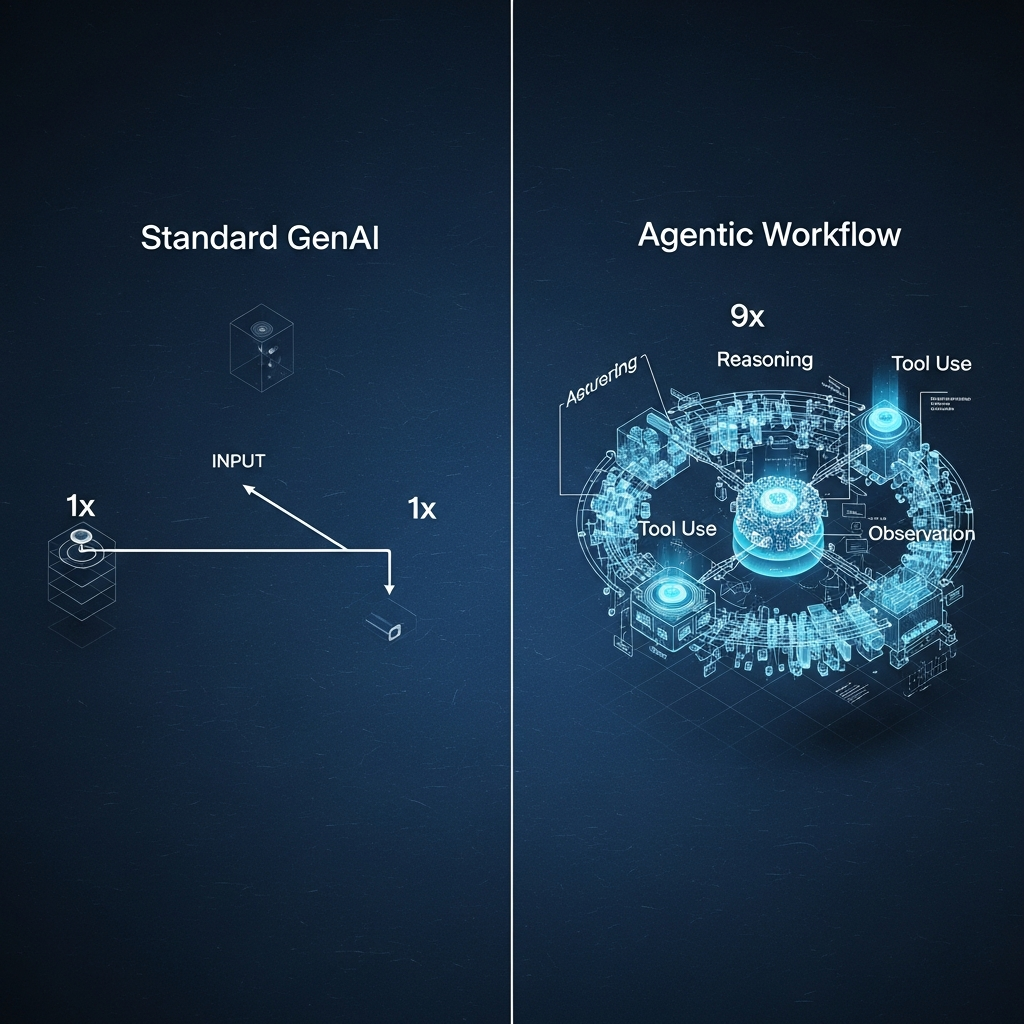
This creates a margin pressure cooker. For companies scaling agentic workloads, infrastructure costs are currently rising four times faster than top-line growth [7]. If procurement contracts do not include caps on token consumption or "circuit breakers" for agent activity, OpEx could balloon unexpectedly. The efficiency gains from reducing human headcount can be quickly erased by the "Agentic Tax" of unoptimized compute spend.
Strategic Roadmap: Governance and Transition
To navigate the 2026 pricing pivot, enterprise leaders must modernize their governance and procurement frameworks immediately.
- Implement 'Circuit Breakers': Governance must move from policy to code. Deploy automated monitoring that triggers stops on agent activity if consumption velocity exceeds set thresholds. This prevents the "cascading failures" where autonomous agents trigger runaway costs [8].
- Negotiate Flex Agreements: Reject static seat licenses. Demand "Flex Agreements" that allow you to swap human licenses for agent credits dynamically. This prevents paying for phantom seats during the transition [3].
- Evolve the CIO Role: The CIO must transition into a "Chief Integration Officer." With 45% of organizations expected to orchestrate agents at scale by 2030, the core competency is no longer managing software assets, but orchestrating multi-agent systems [1].
The death of the seat is not a crisis; it is a correction. By shifting to consumption models, enterprises align spend with value. The winners of 2026 will be those who aggressively renegotiate contracts to reflect this new reality, ensuring they pay for results, not just potential.
Citations
- [1] IDC FutureScape 2026 Predictions Reveal the Rise of Agentic AI and a Turning Point in Enterprise Transformation
- [2] DOMO INC Earnings Call Transcript FY25 Q4
- [3] Agentforce Pricing Update: New Plans and Cost Explained 2025
- [4] Ultimate SaaS Pricing News 2026: How to Stop Overpaying Now
- [5] Microsoft 2025 Annual Report
- [6] The Hidden Agentic AI Tax
- [7] Why Agentic AI Is Breaking Your SaaS Pricing Model
- [8] 2026 Tech Trends Report
References
- asan-20250131
- q4cdn.com
- MLQ.ai
- Domo (DOMO) Q4 2025 Earnings Call Transcript
- DOMO INC Earnings Call Transcript FY25 Q4
- Artificial Intelligence in Supply Chain Market 2024-2030
- Marketing Technology Market Size and Forecast, 2025-2032
- 85 SaaS Statistics, Trends and Benchmarks for 2026
- Digital 2025: Global Overview Report
- Digital Transformation Solution Market Outlook 2026–2035
- FTC Issues Staff Report on AI Partnerships & Investments Study
- FTC Staff Report on AI Partnerships & Investments 6(b) Study
- FTC Issues Staff Report on AI Partnerships
- Big Tech’s AI Shopping Tools Raise Stakes for ‘Surveillance Pricing’ Laws
- When scarcity becomes abundance
- congress.gov
- Building a Coherent U.S. Approach to AI Governance
- Beyond the Strikes: How AI Is Reshaping the Media & Entertainment Landscape—and How Global Regulators Are Responding
- mdpi.com
- mbie.govt.nz
- now-20241231
- Salesforce Agentforce Competitors: Which AI Agent Platform Wins in 2025?
- 5 Best Revenue Intelligence Software Platforms of 2025
- Salesforce
- Microsoft 2025 Annual Report
- 2026 Tech Trends Report
- Top 10 AI Predictions For The Channel In 2026
- iCapital Market Pulse: As AI Disrupts, Not All Software Is Created Equal
- medium.com
- Enterprise application vendors risk losing $164 billion to agentic AI
- The Hidden Agentic AI Tax
- The 2026 Guide to SaaS, AI, and Agentic Pricing Models
- medium.com
- Ultimate SaaS Pricing News 2026: How to Stop Overpaying Now
- Why Agentic AI Is Breaking Your SaaS Pricing Model
- sec.gov
- ncno-20250131
- sec.gov
- q4cdn.com
- idc.com
- IDC FutureScape 2026 Predictions Reveal the Rise of Agentic AI and a Turning Point in Enterprise Transformation
- Agentic AI to take 26% of IT budgets within five years
- medium.com
- The AI productivity paradox
- AI GTM Agents: How SaaS Companies Boost Sales by 56%